We’ve seen how individual neurons react to their input. That input usually comes from other neurons. When a neuron fires, an action potential (wave of electrical activity) travels along its axon. The junction where one neuron communicates with another is called a synapse.

A pre-synaptic action potential causes the release of a neurotransmitter, which binds to the receptors of the post-synaptic neuron, opening ion channels and thereby changing the membrane potential.
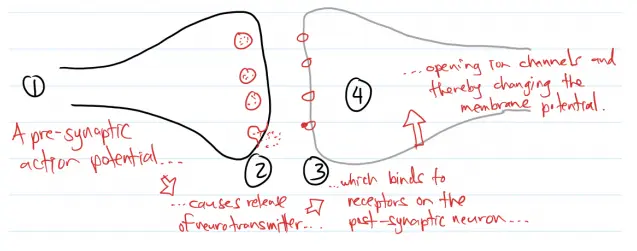
Neurons are separated by microscopic small space called the synaptic cleft, which is around 20-50mm wide.
Post-Synaptic Current
Even though an action potential is very fast, the synaptic processes by which it affects the next neuron take time. Some synapses are fast (~10ms), and some are slow (~300ms). If we represent that time constant using ,l then the current entering the post-synaptic neuron can be written as:
where is chosen so that
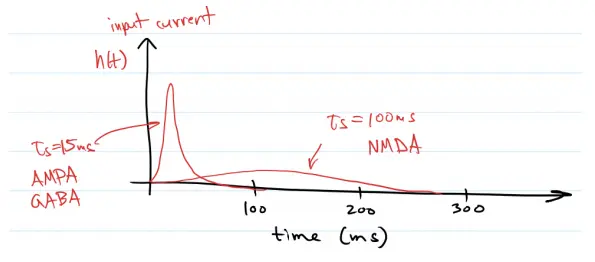
The function is called a Post-Synaptic Current (PSC) filter, or Post-Synaptic Potential (PSP) filter.
Multiple spikes form a spike train, and can be modeled as a sum of Dirac delta functions:
Dirac Delta Function
The Dirac Delta Function is defined as
with the properties
The second equation there basically means that we can use the Dirac delta function that sample the value of a function at a specific .
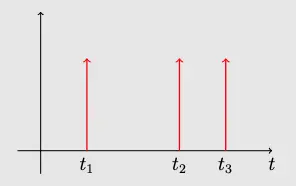
How does a spike train influence the post-synaptic neuron? We can simply add together all PSC filters, one for each spike. This is actually convolving the spike train with the PSC filter:

That is:
which is the sum of the PSC filters, one for each spike, also known as the filtered spike train.
Post-synaptic current for a random spike train with . The PSC captures some information about the pre-synaptic spike train history:
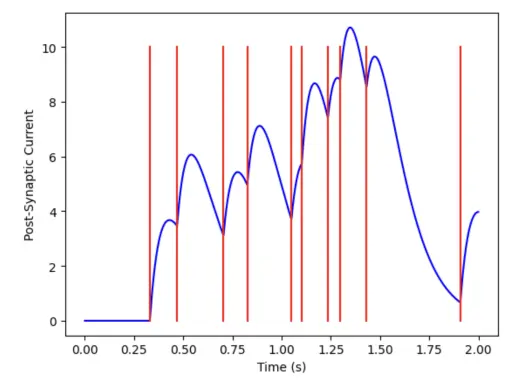
Interestingly, for a constant firing rate of and , we observe that the post-synaptic current saturates to a constant value, which is determined by the pre-synaptic firing rate .
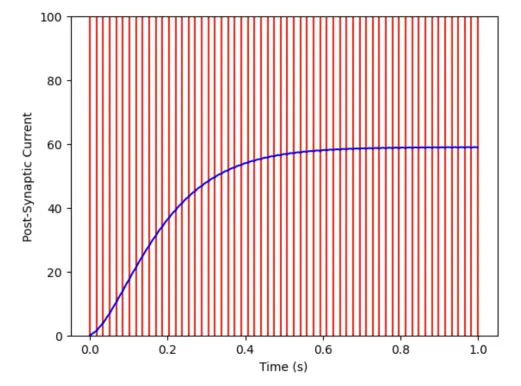
More specifically, if we plot the asymptotic value of the post-synaptic current (PSC) against the firing rate, we find a linear relationship
as demonstrated in the following plot:

Connection Weight
The total current induced by an actual potential onto a particular post-synaptic neuron can vary widely, depending on:
- The number of sizes of the synapses
- The amount and type of neurotramsitter
- The number and type of receptors
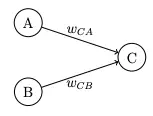
We can combine all those factors into a single number, the connection weight. Thus, the total input to a neuron is a weighted sum of filtered spike-trains.
Weight Matrices
When we have many pre-synaptic neurons, it is more convenient to use matrix-vector notation to represent the weights and activities.
Suppose we have two populations and , where:
- has nodes
- has nodes
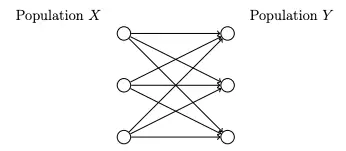
If every node in sends its output to every node in , we will have a total of connections, each with its own weight.

The weights can be represented as a matrix
Vectors of Neuron Activities
We typically store the neuron activities in vectors:
We can compute the input to the nodes in using
where holds the biases for the neurons in .
Thus,
where represents and activation function.
Bias Representation
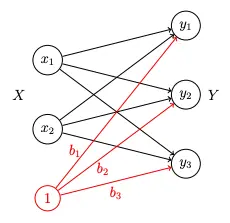
Another way to represent the biases, , is by adding an additional input node with a fixed value of .
Implementing Connections Between Spiking Neurons
For simplicity, let :
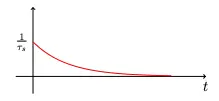
Theorem
The function defined above is the solution of the initial value problem (IVP):
Full LIF Neuron Model
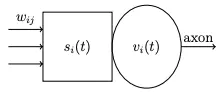
The dynamics of the neuron can be defined by:
If reaches 1:
- Start refractory period
- Send spike along the axon
- Reset to 0
If a spike arrives from neuron : Increment using