he Hodgkin-Huxley Neuron Model is already vastly simplified. However, to model a single action potential takes many timesteps. However, spikes are fairly generic, and it is thought that the presence of a spike is more important than its specific shape.
Leaky Integrate-and-Fire (LIF) Model
The LIF model only considers the sub-threshold membrane potential (voltage), but does NOT model the spike itself. Instead, it simply records when a spike occurs (i.e., when the voltage has reached the threshold).
where is input current, is a capacitance, and is a conductance. The complete second term is a leak current term that is comprised of conductance multiplied by how far we are away from the equilibrium voltage. is an input current.
Multiplying everything by :
- term is in units of time and gets defined as .
- using Ohm’s Law
Thus, the voltage can be modeled as:
- Only valid for (dynamics of sub-threshold voltage)
We use a change of variables to simplify this. First, we define:
which essentially normalizes the along the entire to range. Then if , and is the threshold.
Substituting into our differential equation, we get
- This has the same form as in Hodgkin-Huxley Neuron Model; it’s basically just a leaky integrator, adding up its input until it reaches equilibrium (at a rate determined by its time constant).
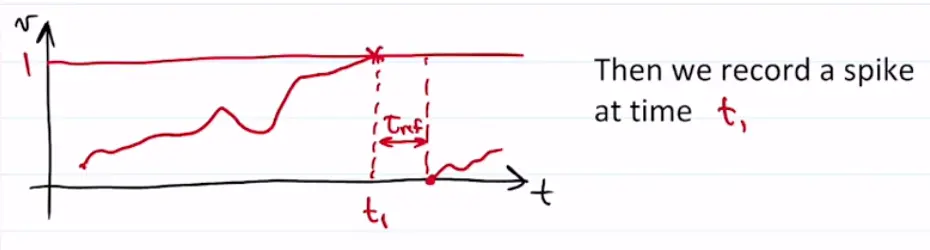
We integrate the differential equation for a given input current (or voltage) until reaches a threshold value of . At this point we record a spike. After it spikes, it remains dormant bit for (refractory period), and then we start integrating again from zero.
LIF Firing Rate
Suppose we hold the input, , constant. We can solve the DE analytically between spikes. Specifically, we claim that
is a solution of , . We can prove this easily by plugging this into the equation and showing that LHS = RHS.
Visually, this will look like approaching asymptotically as increases:
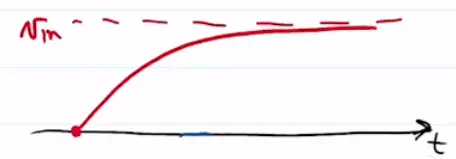
Note that , as is the threshold where we trigger a spike. After the spike, we enter the refractory period and start integrating again with the same trajectory.
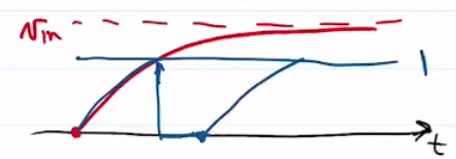
The firing rate can be found as , where is the inter-spike interval (time between two spikes). The inter-spike interval includes the refractory period , as well as , which is the time it takes to go from to .
It can be shown that the steady-state firing rate for a constant input is
The plot below shows the firing rate for various input . Note again that for the neuron to start firing! This is called the tuning curve, which tells us how the neuron reacts to different input currents.
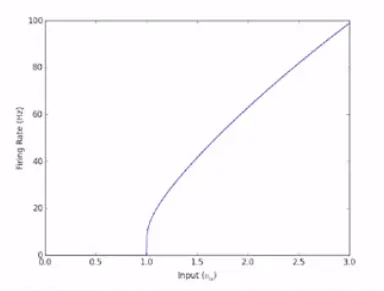
Typical value for cortical neurons: , .