For real-valued genetic algorithms, we need crossover and mutation operators that directly operate on real-valued chromosomes.
Crossover
Methods:
Mutation
Mutation acts on a single parent at a time. Given a parent , mutation samples:
where is a random perturbation.
Gaussian Mutation
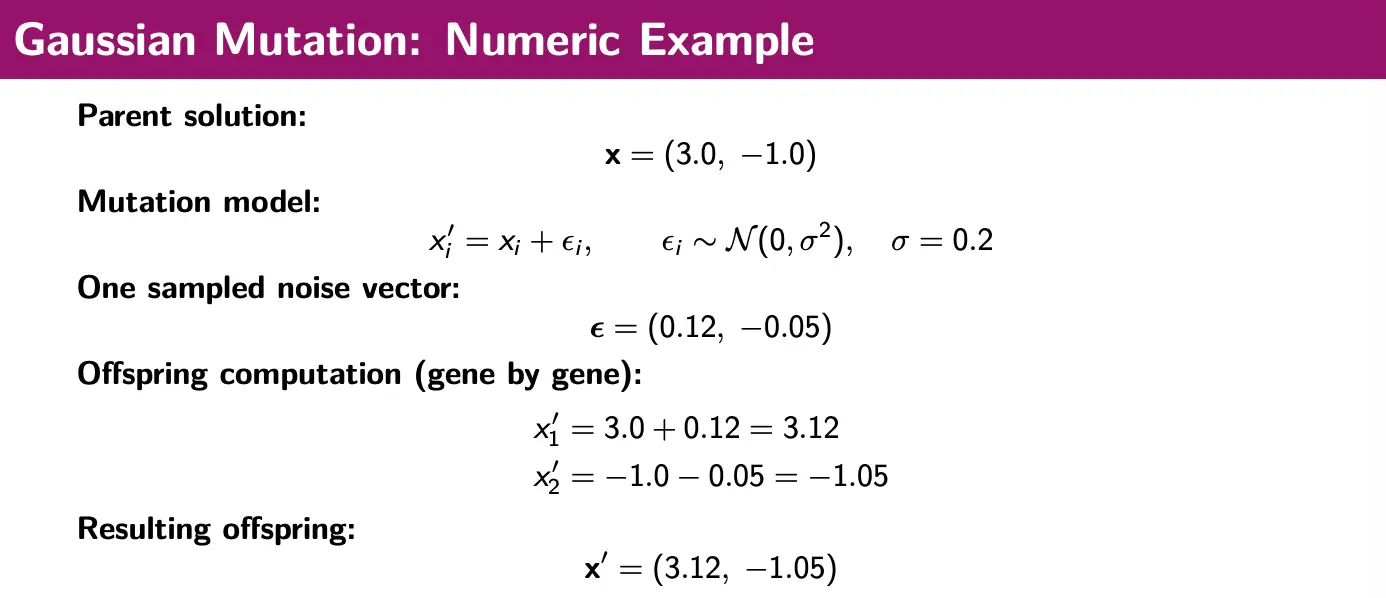
A Gaussian mutation is a standard operator for real-valued chromosomes. For each gene:
This is centered around the parent value , with mostly small mutations and occasional larger steps. The parameter sets the mutation strength.
Adaptive Gaussian Mutation
Mutation strength can be changed over generations, while the mutation distribution remains Gaussian.
At generation :
We use large early for strong exploration, then small later for finer exploration.
Boundary Handling
Real-valued mutation can produce infeasible values outside of our constraints:
This is common when mutation strength is large (early generations). We can use the same strategies as covered in Constraints in Real-Valued GA: clipping, reflection, resampling.
Mutation Strength vs. Convergence
If we have too large, we will have random walk behavior with poor convergence. If it is too small, we will converge prematurely due to loss of diversity.
Note that some variables require finer perturbations than others!