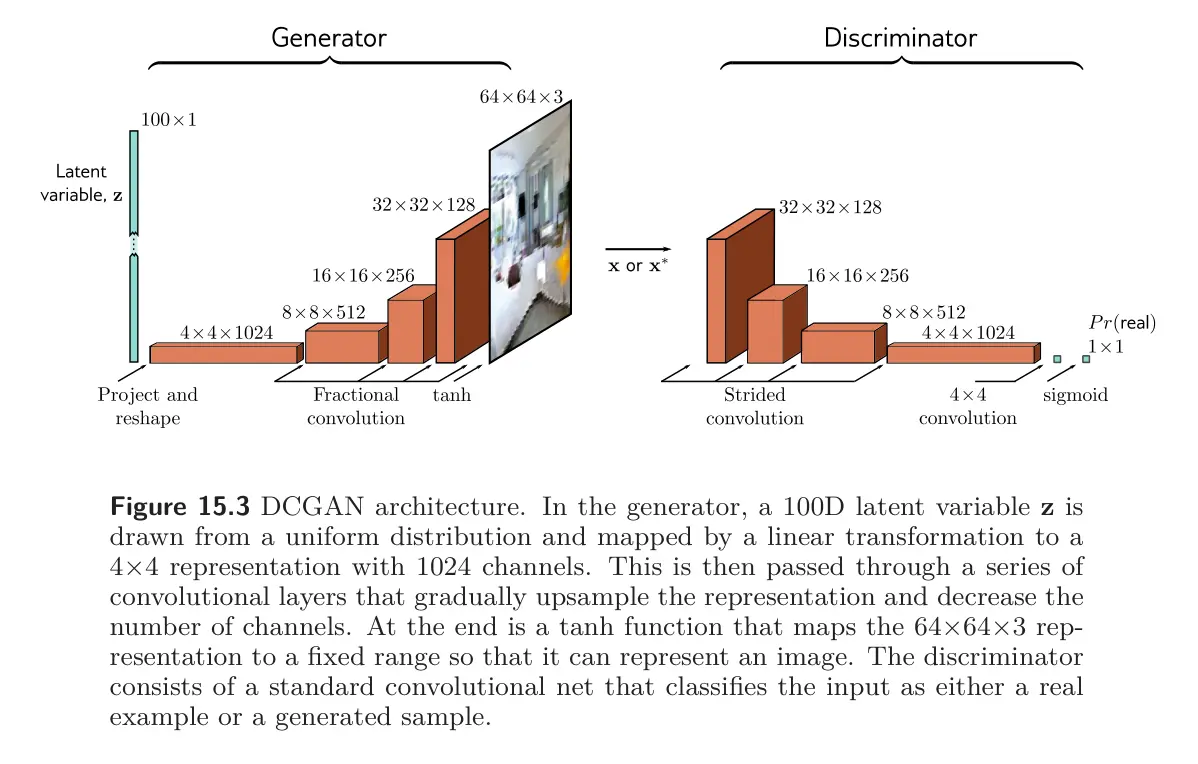
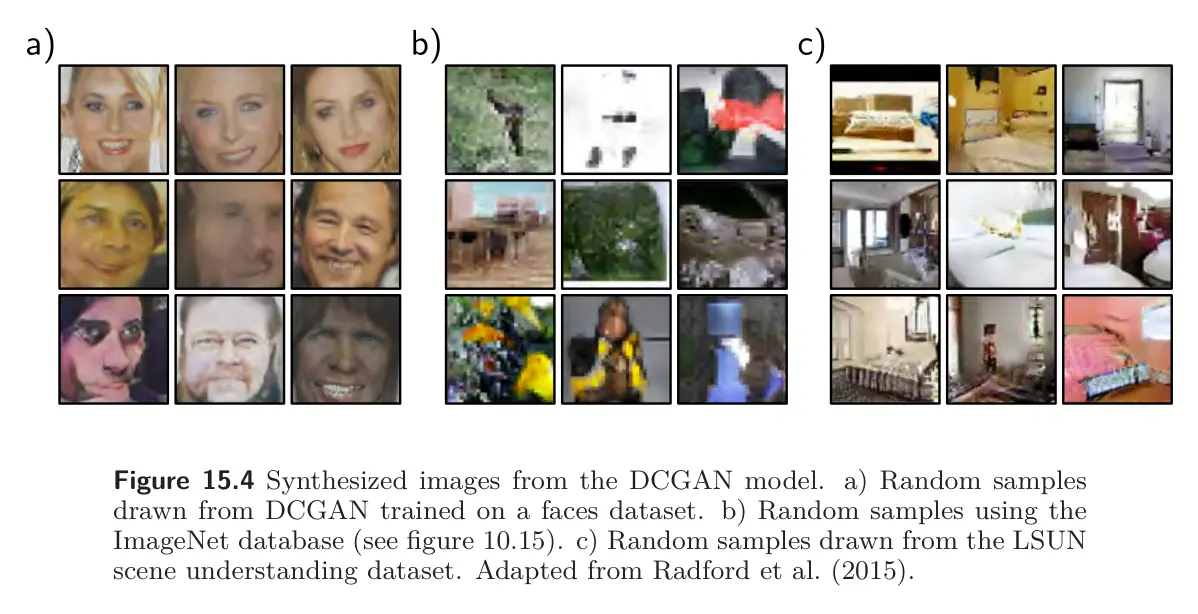
DCGAN was an early GAN architecture specialized for image generation.
- The input to the generator is a 100D latent variable sampled form a uniform distribution.
- This is then mapped to a spatial representation with 1024 channels using a linear transformation.
- Four convolutional layers follow, each of which uses a convolution that doubles the resolution (stride of 0.5).
- At the final layer, the signal is passed through a function to generate an image in the range .
- The discriminator is a standard convolutional network where the final convolutional layer reduces the size to with one channel. This single number is passed through a sigmoid function to create the output probability.
- After training, the discriminator is discarded. To create new samples, latent variables are drawn from the base distribution and passed through the generator.