The cell assignment problem in PCS (personal communication services) networks is difficult.
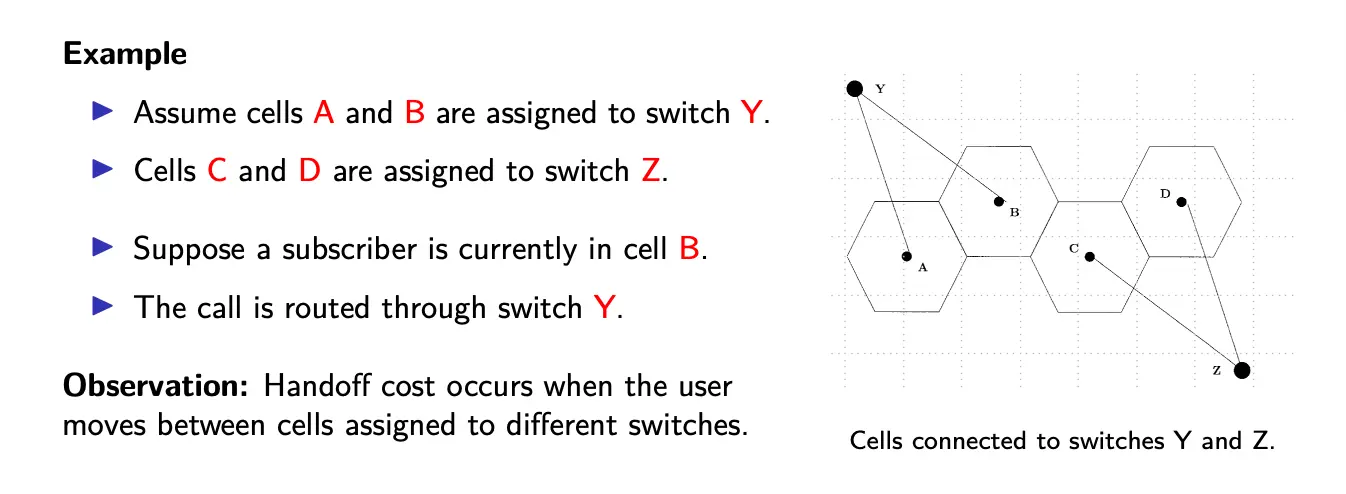
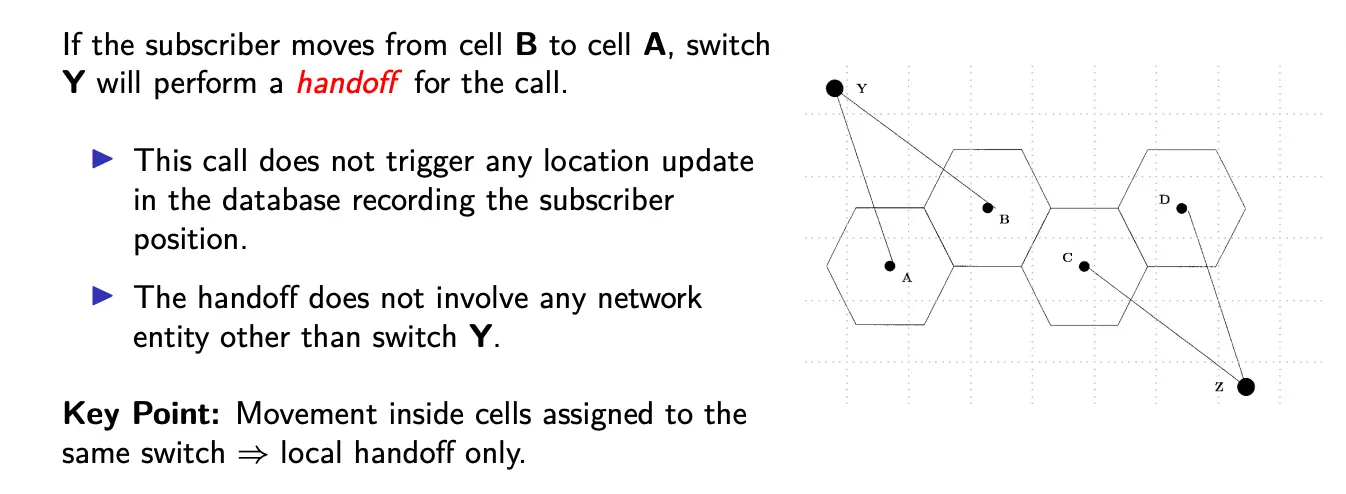
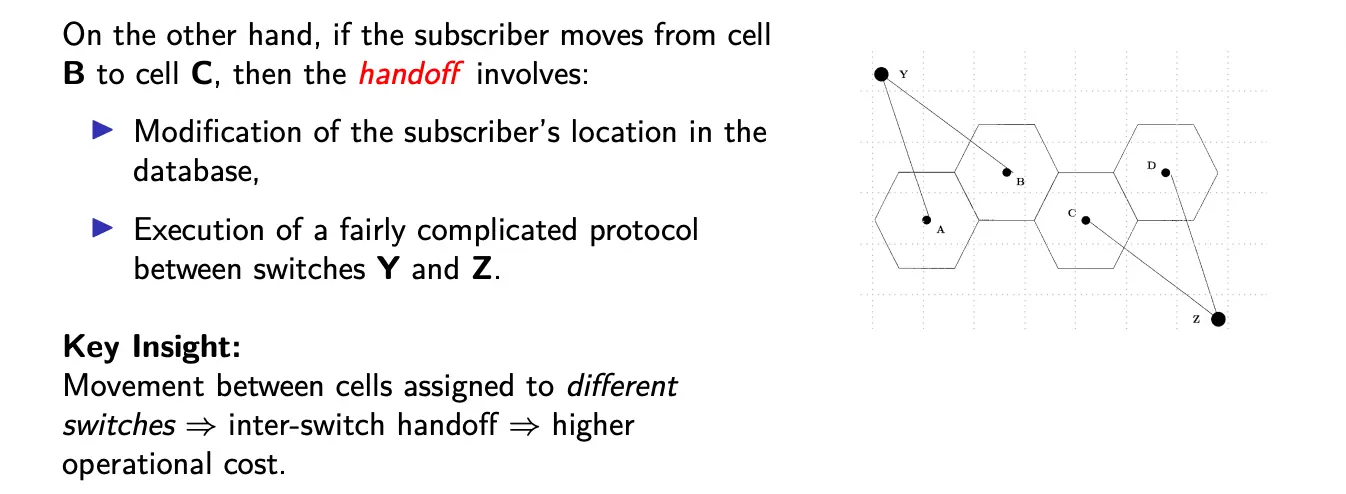
Each cell has an antenna used to communicate with subscribers, occurring over pre-assigned radio frequencies. Groups of cells are connected to a switch, which routes traffic to satellite networks. We need to assign frequency channels to cells to minimize interference and maximize channel utilization. Close cells should not have close frequency ranges.
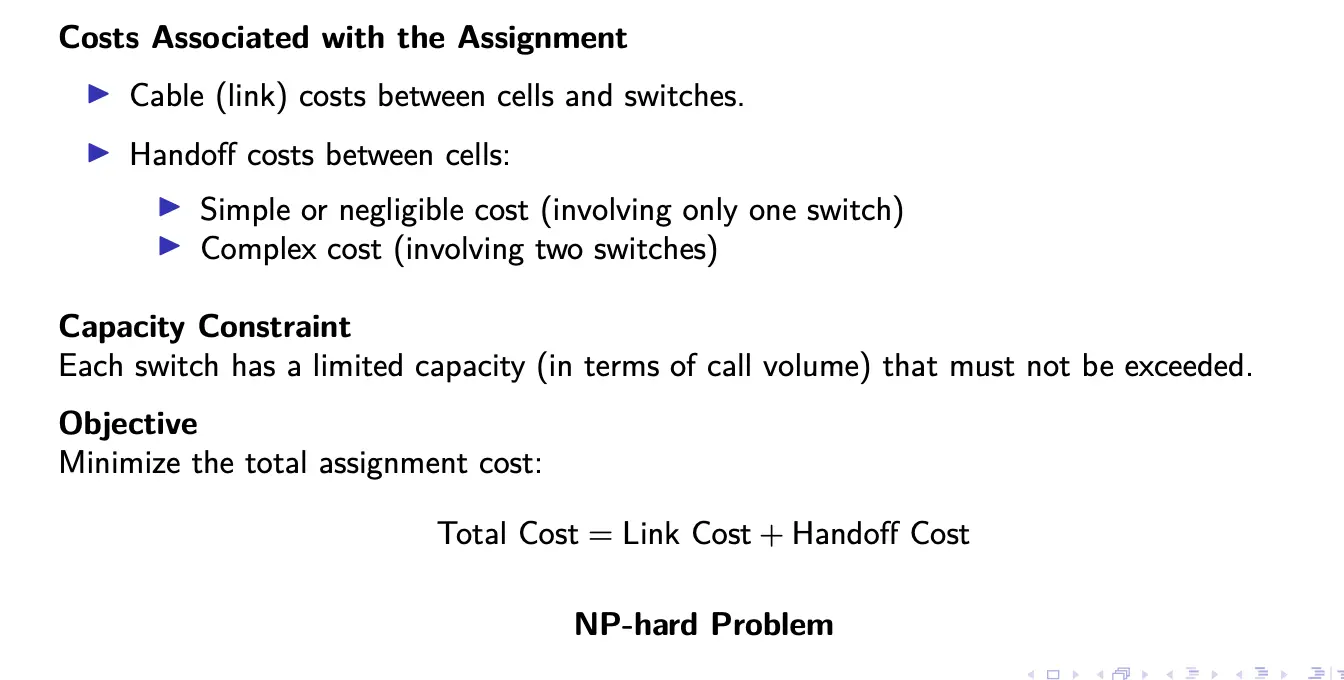
Given cells to be assigned to switches, where each switch has capacity , we need to find an assignment that minimizes:
- Link cost (cell-switch connection)
- Handoff cost (mobility between cells)
Formulated as an ACO problem, each ant makes 2 decisions:
- Choose the next cell to be assigned
- Choose the switch to assign the selected cell to.
Then, we form a pheromone trail associated with every possible assignment of cell to switch .
Other parameters, we need to consider: max number of iterations, number of ants, transition rule, pheromone update rule.
Mathematical Formulation
From the above, we can formulate this into a mathematical problem.
Let be the cost of the link between cell and switch , with and .
Let:
Let
Let be the handoff cost between cells and when they are assigned to different switches.
Let bet he call demand (number of calls) for cell .
The objective is:
Subject to:
ACO Algorithm
Initialization
- Select maximum number of iterations:
- Select number of ants:
Main Loop
- While iteration :
- For each ant ()
- Initialize ant parameters (pheromone, memory, etc.)
- While number of assigned cells :
- Select next cell using transition rule
- Check capacity constraint of selected switch
- Update local problem data (capacity, cost, etc.)
- Evaluate solution using objective function.
- Update pheromone trail (deposit + evaporate)
- Retain best solution among all ants
- Optionally reinforce pheromone based on global best
- For each ant ()
Transition Rules
Let be the set of switches not yet assigned. The transition probability is:
This is a simple selection ratio based purely on pheromone, with no heuristic information, encouraging learned assignments.
If we want to add heuristic information:
We can use heuristic information to reflect utilization or assignment cost, or bias ants toward promising switches. For example:
Pheromone Update and Evaporation
Standard rule:
Alternative form:
can be density-based, quantity-based (local cost), or online/delayed (solution quality).