An assembly line is made of workstations arranged in series and in parallel. The production program consists of a set of tasks with precedence relations that need to be assigned to the workstations.
Each task requires processing time and space .
Each station has a cycle time , to carry out a subset of tasks assigned to it (workload) and space area .
Typically, the cycle time is the same for all workstations, , which determines the production rate . The cycle time represents an upper limit of the total time required by the tasks assigned to the workstation.
is the idle time of workstation . Total idle time is sum of all idle times over all stations.
The main object is to assign tasks to workstations to assign one or more of the following:
- Minimize the number of workstations given a fixed value for the cycle time and space
- Minimize the cycle time given a fixed number of workstations and
- Minimize total space required given and .
- Give and find a feasible solution (assignment)
We can have multi-objectives, like do 1 and 2 given , or do and given .
Example:
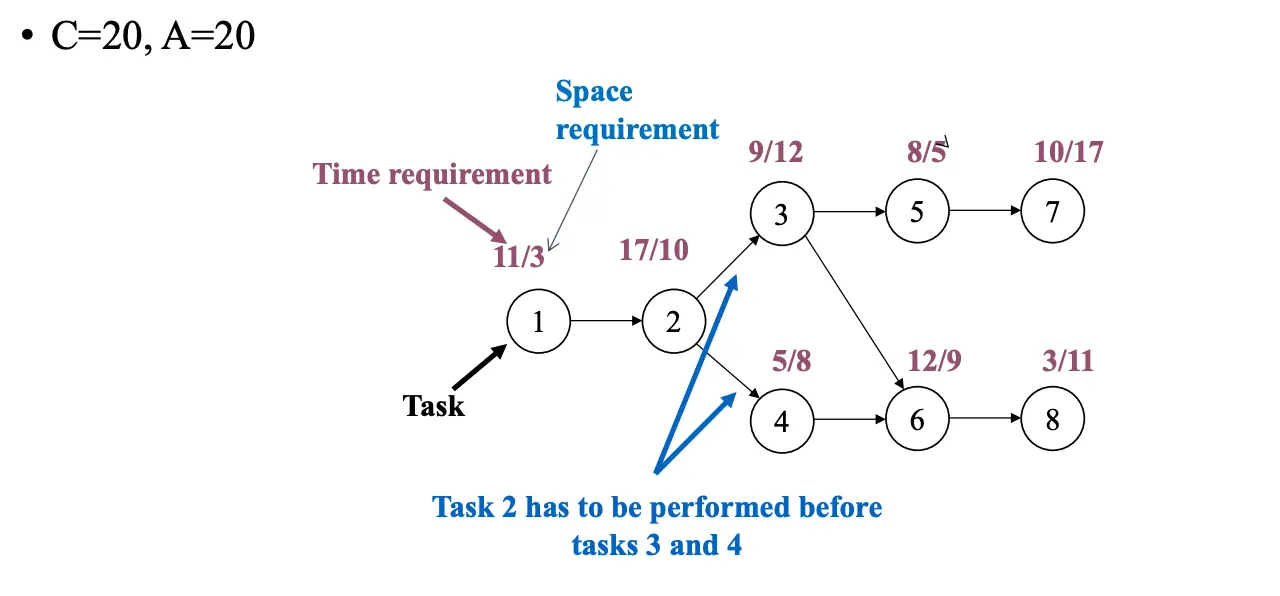
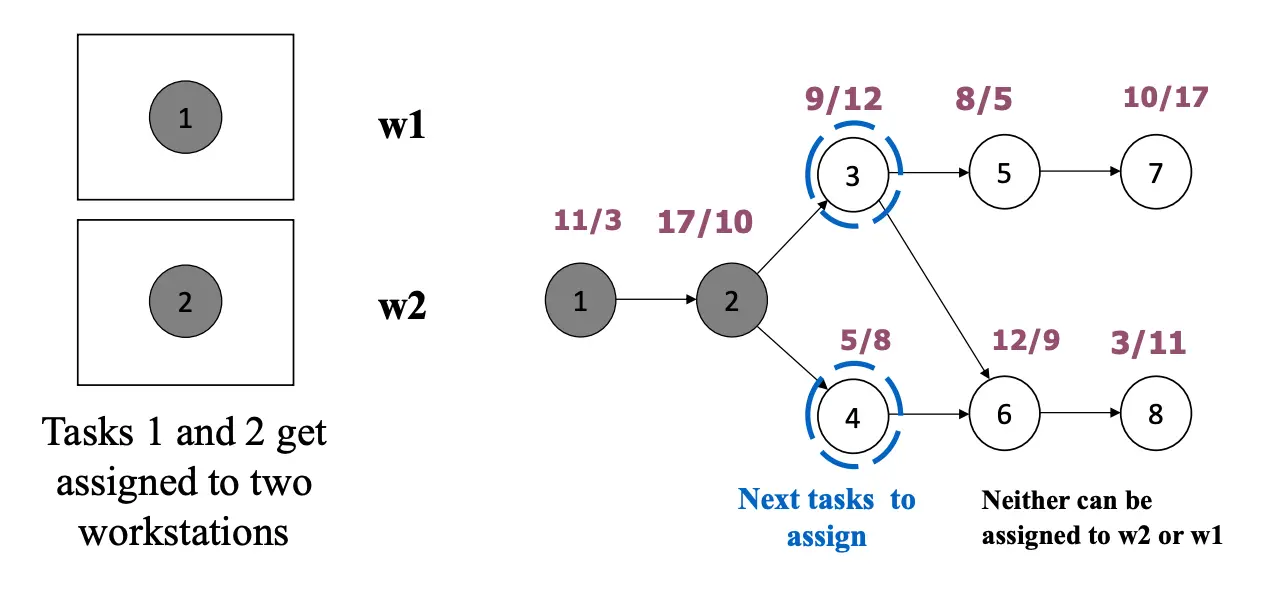
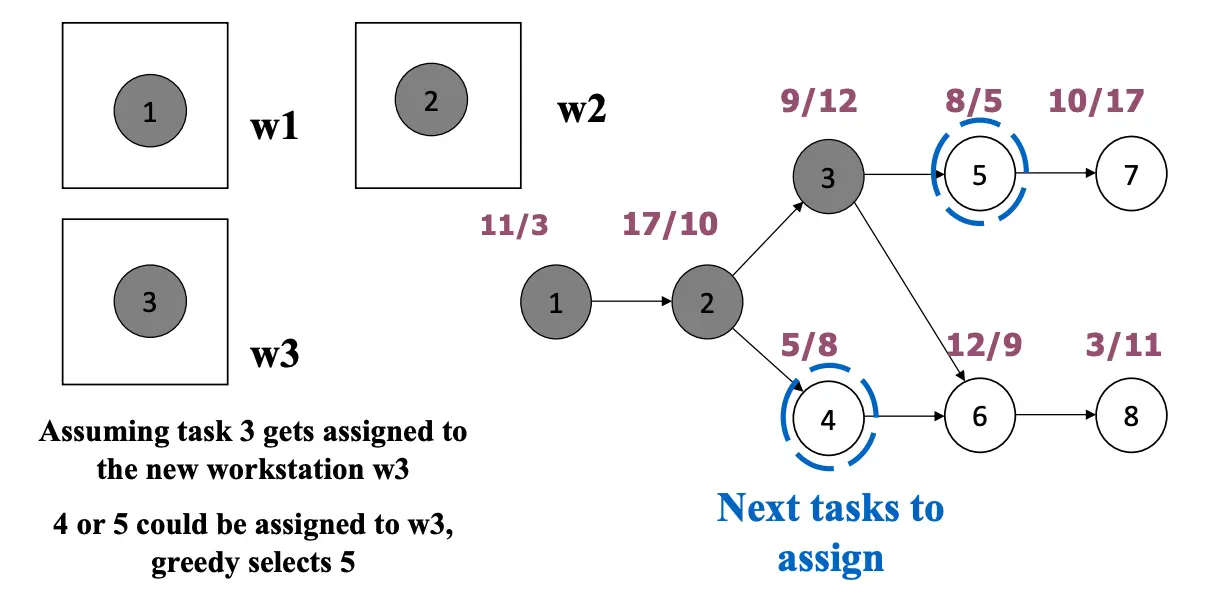
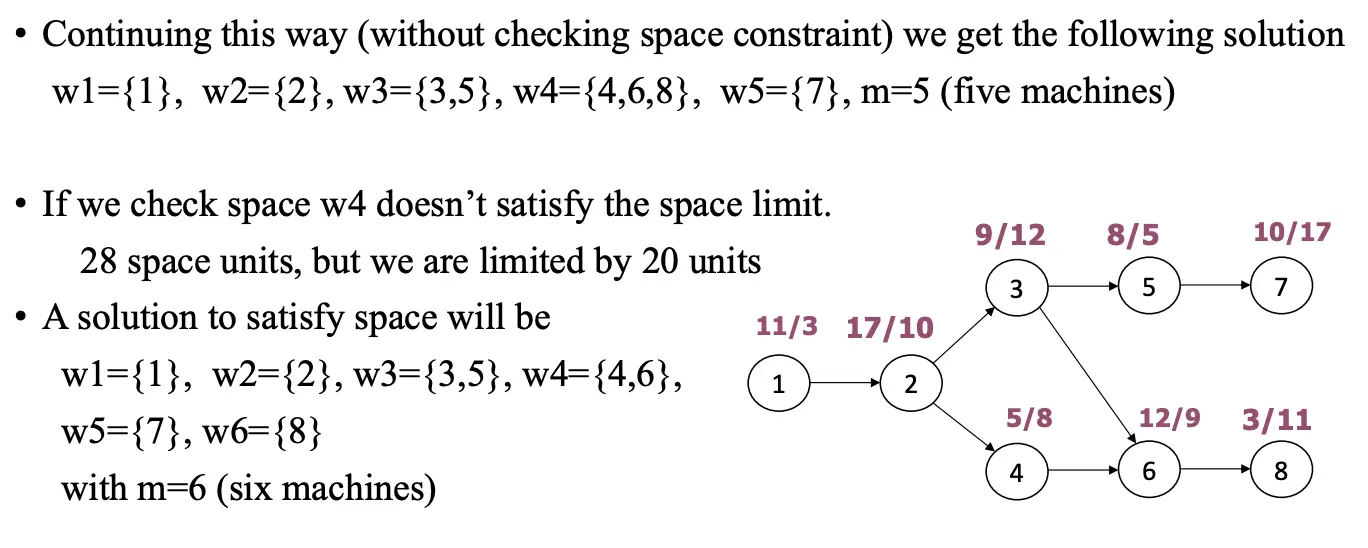
ACO Solution
In TSP, each ant determines which city to add next to the solution, In this problem, each ant determines which assignment (task/workstation) to add next to the solution.
Each different assignment gets a pheromone trail parameter. A pheromone trail is associated with each assignment, where denotes the pheromone trail associated with task getting assigned to workstation .
Let be the set of tasks that are not yet assigned to a work station, whose predecessors are all assigned to work stations.
Then, we:
- Select max no of iterations, itmax
- Select number of Ants, antmax
- While number of iterations < itmax:
- While current ant number < antmax:
- Initialize ant parameters (pheromone, update, …, etc)
- While ( is not empty):
- Select task to be assigned to workstation using transition rule.
- If none of the tasks can be fit in the current workstation due to time or space capacity, open a new workstation
- Update problem data
- End ( is empty)
- Update pheromone trail using update rules and evaporation rule
- Evaluate solution
- Retain best solution of all ants
- Update pheromone trail based on best solution (if desired)
- While current ant number < antmax:
- Return best solution
We can use the standard transition rules.
- Simple ratio
- Heuristics:
Heuristics can be related to utilization
or if the space is checked:
The pheromone update and evaporation rule can be simple:
where can be density, quantity, or online delayed using utilization as solution quality.
We can also use a pheromone update on the best solution: