Mechanical work done by a shaft submerged in water to the internal energy of the water; this energy may then leave the water as heat. However, any attempt to reverse the process will fail. Work can be converted to heat directly and completely, but converting heat to work requires the use of special devices called **heat engines**.
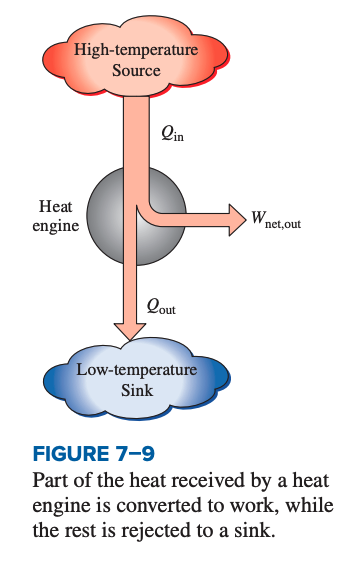
Heat engines all follow these principles:
- They receive heat from a high-temperature source (solar energy, oil furnace, nuclear reactor, etc.)
- They convert part of this heat to work (usually in the form of a rotating shaft)
- They reject the remaining waste heat to a low-temperature sink (the atmosphere, rivers, etc.)
- They operate on a cycle.
Heat engines and other cyclic devices usually involve a fluid to and form which heat is transferred while undergoing a cycle. This is called the working fluid.
Steam Power Plant
A steam power plant is an example of a heat engine. Combustion takes place outside the engine, and the thermal energy released during this process is transferred to the steam as heat. The schematic of a basic power plant is shown.
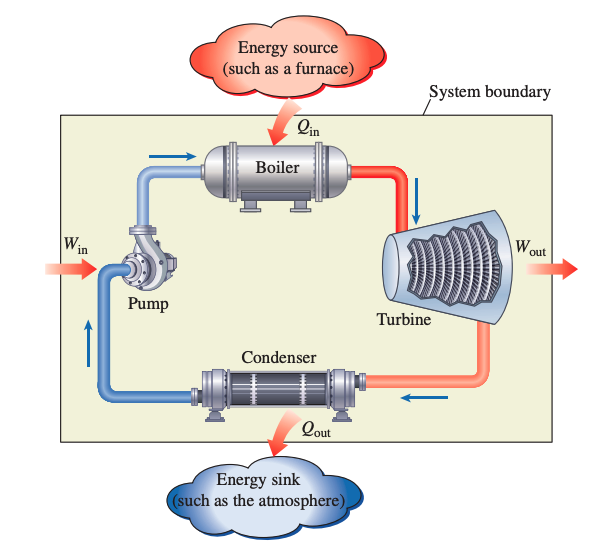
- is the amount of heat supplied to the steam in boiler from a high-temperature source.
- is the amount of heat rejected from steam in condenser to a low-temperature sink
- is the amount of work delivered by steam as it expands in turbine.
- is the amount of work required to compress water to boiler pressure.
The net work output is then:
Recall that for a closed system undergoing a cycle, the change in internal energy is zero, and therefore the net work output of the system is also equal to the net heat transfer to the system: