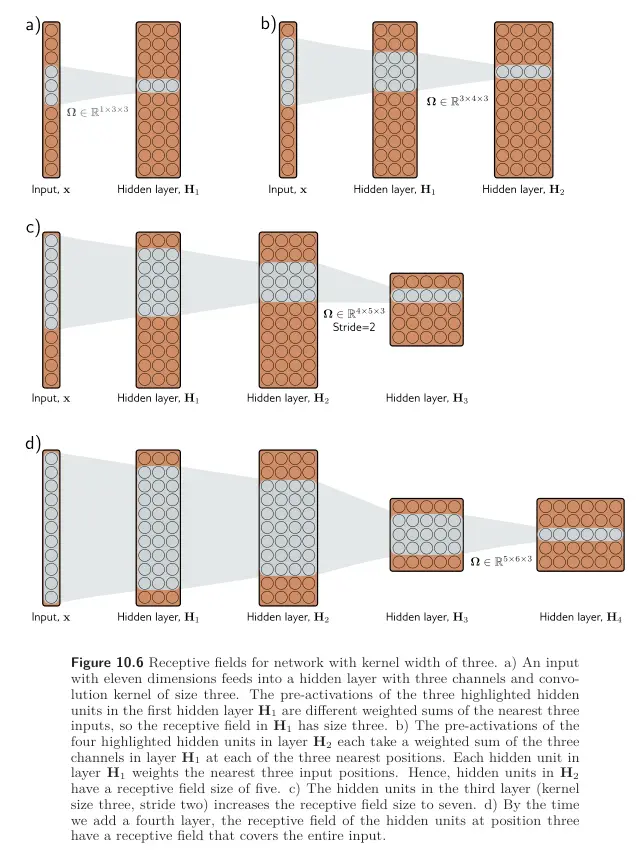
Convolutional Neural Networks consist of a sequence of convolutional layers. For a given hidden unit in the network, its receptive field is the region of the original input that feeds into it.
Consider a convolutional network where each convolutional layer has kernel size 3.
- The hidden units in the first layer take the weighted sum of the three closest inputs, so have receptive fields of size 3.
- The units in the second layer take a weighted sum of the three closest positions in the first layer, which are themselves weighted sums of three inputs. Hence, the hidden units in the second layer have a receptive field of size 5.
Thus, the receptive field of units in successive layers increases, and information from across the input is gradually integrated.
In general, the receptive field at a hidden layer can be calculated as:
where:
- is the receptive field size
- is the convolutional kernel size
- is the jump/stride in the original input between adjacent features.
See UDL Problem 10.16 for a demonstration of this calculation.