Simulated Annealing explores proposed neighbors . The size of controls how far the algorithm can move.
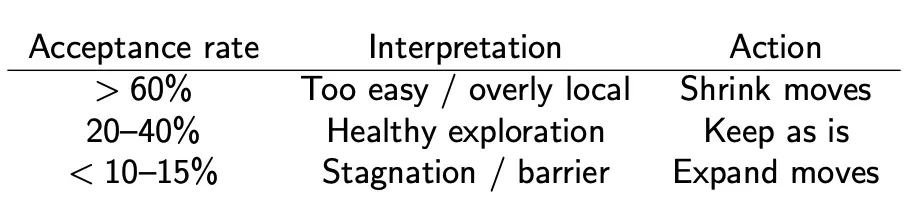
In the early stages of the search, we want a larger neighborhood, which allows for disruptive moves that can cross energy barriers and structural traps. In the later stages, we want smaller neighborhoods that provide fine-grained local refinement. We can find the right neighborhood by using an acceptance-based rule:
where
This essentially provides a feedback signal about the local shape of the cost landscape, whether the current neighborhood is too small or large, and whether the search is progressing or stagnating.
What does high/low acceptance mean exactly?
A high acceptance means that many proposed neighbors are accepted. Thus, many moves have small or negative , such that the landscape is locally smooth. If we allow large moves in this case, we might overshoot good regions or destroy promising structure. Thus, we reduce the neighborhood radius.
- Search is moving easily → slow down and refine
Low acceptance rate means that many proposed neighbors are rejected. Small moves do not improve the solution, so the search might be trapped in a local minimum. To escape, we increase the neighborhood radius, allowing large structural changes.
- Small steps are insufficient → jump further.
This reduces the manual benefit tuning necessary for SA, improving robustness across problem instances, and prevents premature freezing or endless wandering.
Rule of thumb: