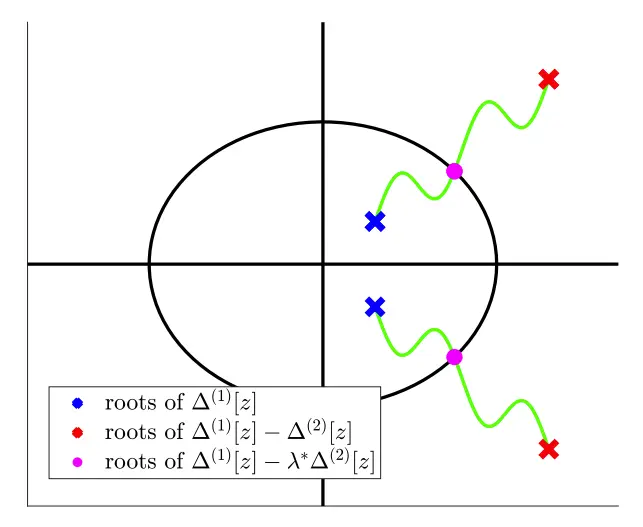
If Λ1[z] is Schur and Λ1[z]−Λ2[z] is not Schur (or vice versa), then there exists λ∗∈[0,1] such that Δλ∗[z] has a root on the unit circle.
Visual intuition:
Recall:
Lemma
Suppose ∣cn∣>∣c0∣.
Then Δ[z] is Schur if and only if R[z] is Schur.
Proof:
Given: ∣cn∣>∣c0∣
WTS: Δ[z] is Schur ⟺R[z] is Schur ⟺zR[z] is Schur
For λ∈[0,1], let Δλ[z]=Δ[z]−λcnc0Q[z]. We then have
⟹Δ0[z]=Δ[z] and Δ1[z]=Δ[z]−cnc0Q[z]=zR[z]
WTS: Δ0[z] is Schur ⟹Δ1[z] is Schur.
Assume toward a contradiction that one of Δ0[z],Δ1[z] is Schur and the other is not. By the boundary crossing lemma, there exists λ∗∈[0,1] such that Δλ∗[z] has (at least) one root on the unit circle, which we call p. Then, we must have:
Δ[p]=0=Δ[p1] since p=p1Δ0[p]=Δ[p]=0Δ1[p]=Δ[p]−cnc0pnΔ[p1]=0⟹p is an unstable root of both Δ0[z] and Δ1[z]⟹contradicts the assumption that one of Δ0[z] and Δ1[z] is Schur
Case 2:p=ejθ,θ=0,θ=π. Then, we have a conjugate p=e−jθ=ejθ1=p1. Δλ∗[z] has real coefficients, so its roots come in complex conjugate pairs. Thus, p=p1 is also a root of Δλ∗[z]:
Thus, p is an unstable root of both Δ0[z] and Δ1[z]. They are both not Schur, which contradicts the assumption that one of Δ0[z] and Δ1[z] is Schur.
Since Case 1 and Case 2 cover all possibilities, it is not possible that Δ0[z] and Δ1[z] is Schur (or vice versa). Therefore, we must have that Δ0[z] is Schur if and only if Δ1[z] is Schur.