Markov process
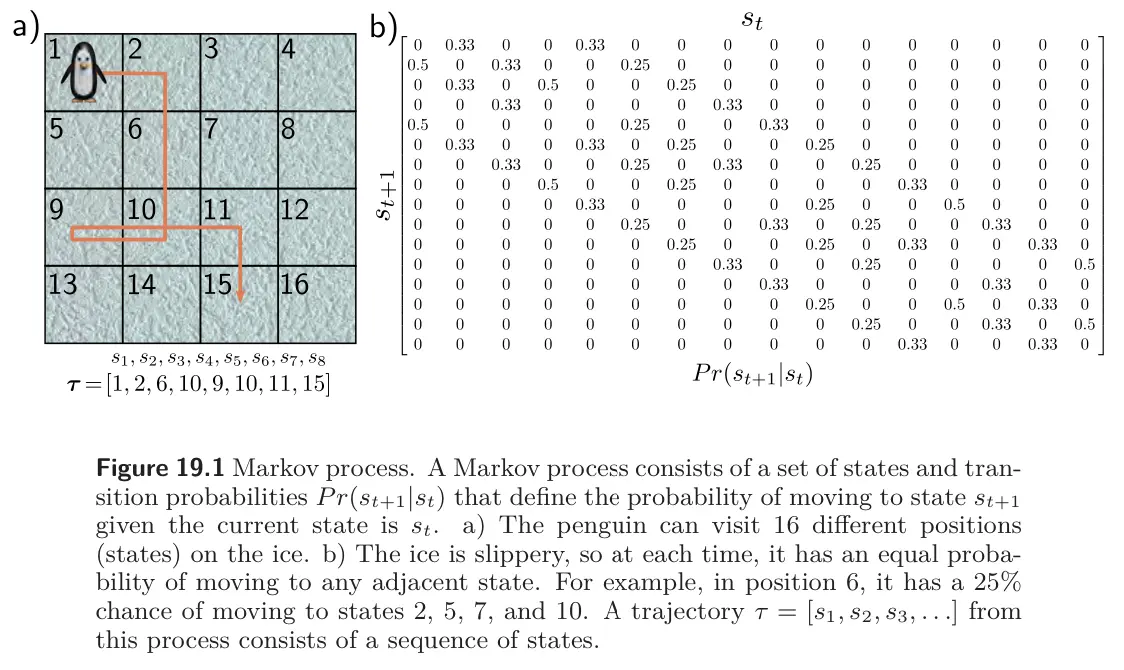
A Markov process assumes that the world is always in one of a set of possible states.
- The word “Markov” implies that the probability of being in a state depends only on the previous states and not on the states before.
- The changes between states are captured by the transition probabilities of moving to the next state given the current state , where indexes the timestep.
- Hence, a Markov process is an evolving system that produces a sequence of states.
Markov Reward Process
A Markov reward process extends the Markov process to include a distribution over the possible rewards received at the next time step, given that we are in state . This produces a sequence of states and the associated rewards.
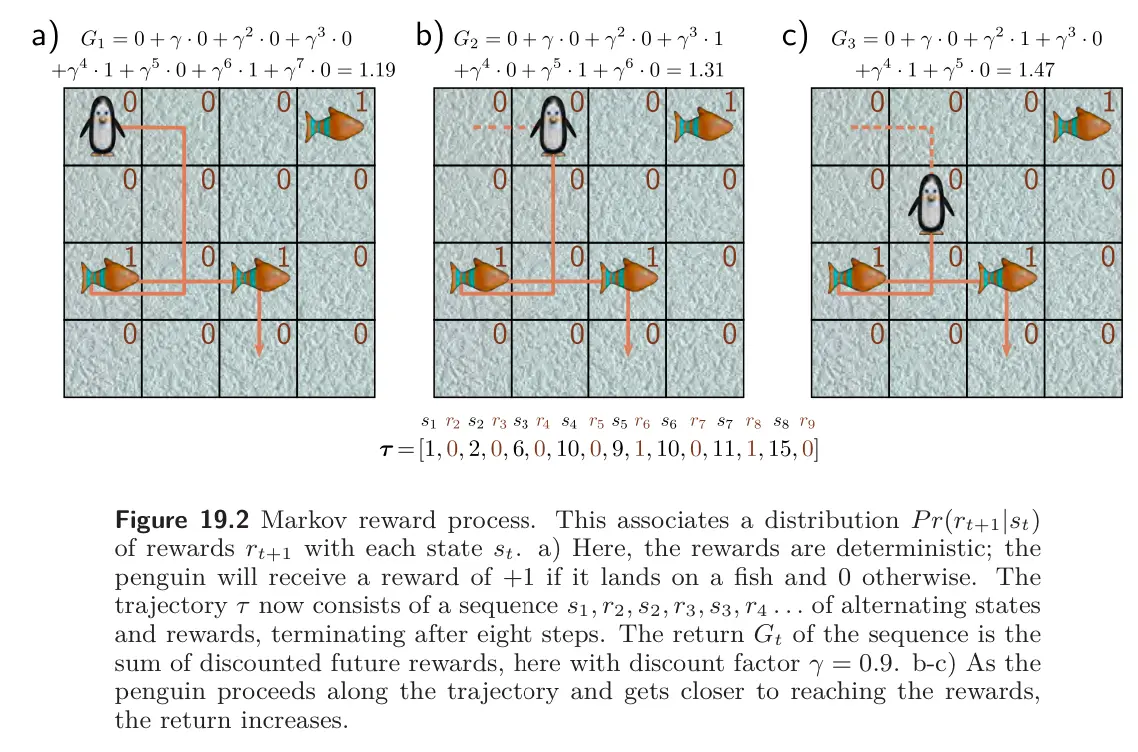
The Markov reward process also includes a discount factor that is used to compute the return at time :
The return is the sum of the cumulative discounted future rewards; it measures the future benefit of being on this trajectory. A discount factor of less than one makes rewards that are closer in time more valuable than rewards that are further away.
Markov Decision Process
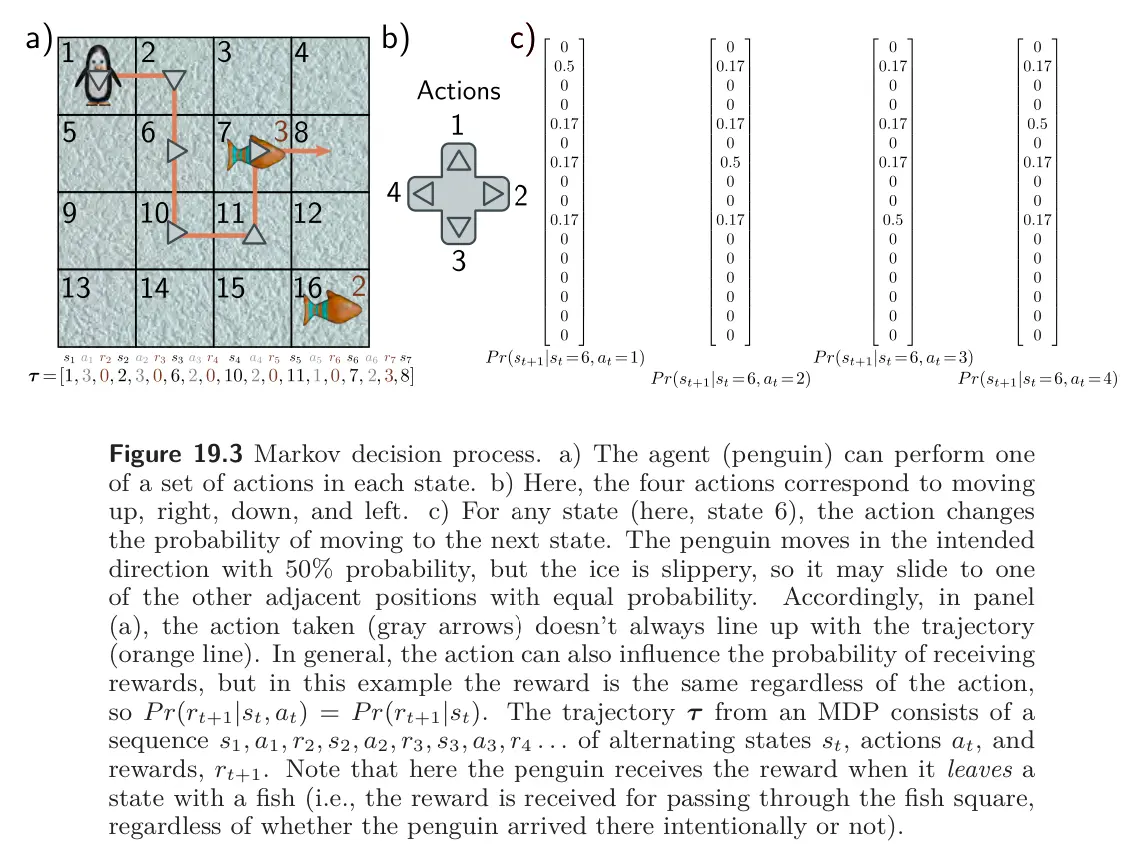
A Markov Decision Process or MDP adds a set of possible actions at each timestep.
- The action changes the transition probabilities, which are now written as .
- The rewards can also depend on the action and are now written as .
- An MDP produces a sequence of of states , actions and rewards which are received at the subsequent timestep.
- The entity that performs the actions is known as the agent.
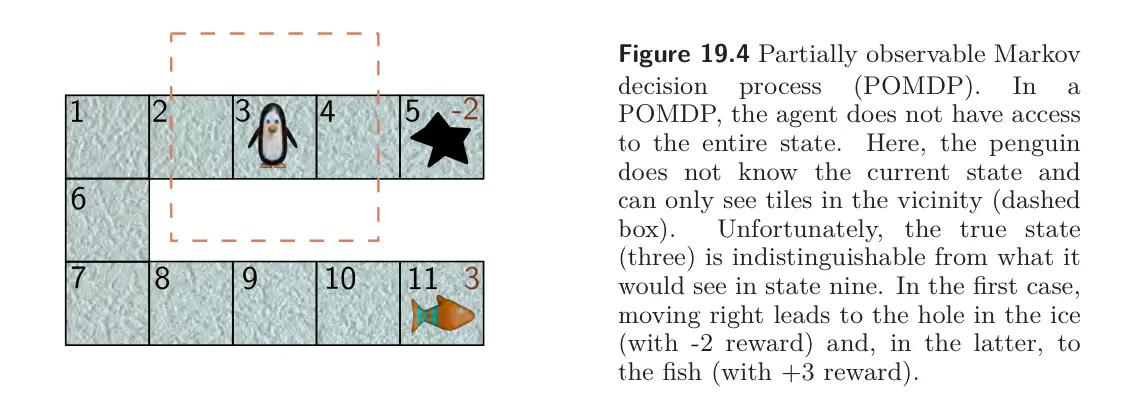
Partially observable Markov decision process
In a partially observable Markov decision process or POMDP, the state is not directly visible. Instead, the agent receives an observation drawn from . Hence, a POMDP generates a sequence of states, observations, actions, and rewards. In general, each observation will be more compatible with some states than others but insufficient to identify the state uniquely.