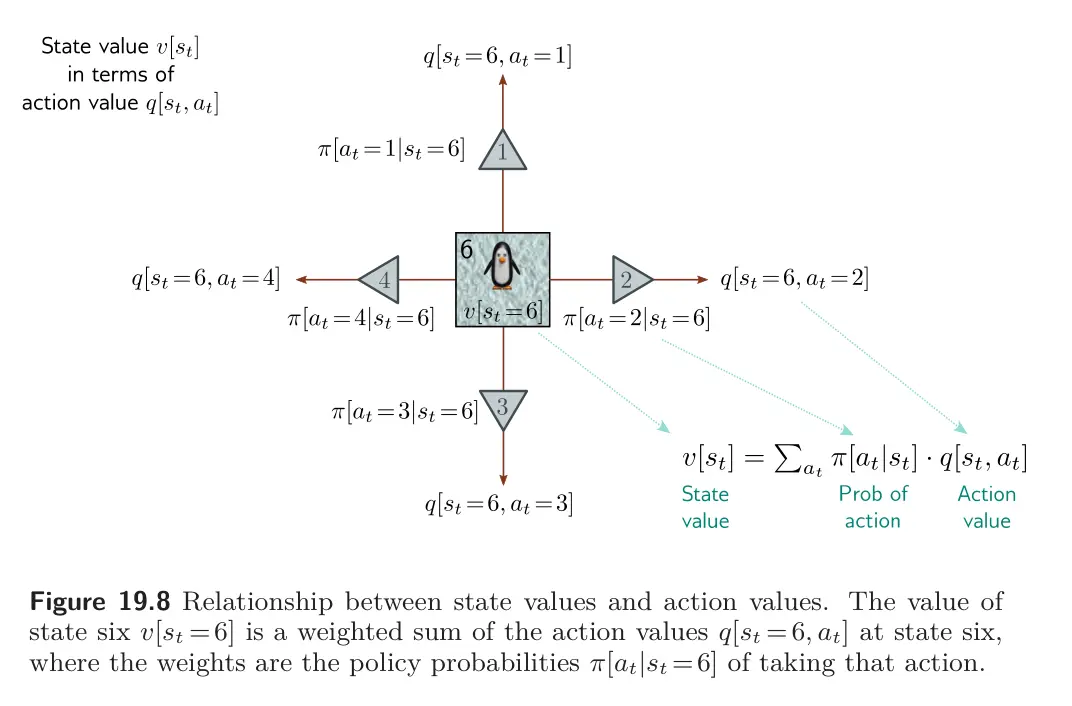
We may not know the state values or action values for any policy. However, we know that they must be consistent with one another, and it’s easy to write relations between these quantities. The state values can be found by taking a weighted sum of the action values , where the weights depend on the probability under the policy of taking that action:
Similarly, the value of an action is the intermediate reward generated by taking the action, plus the value of being in the subsequent state discounted by . Since the assignment is not deterministic, we weight the values according to the transition :
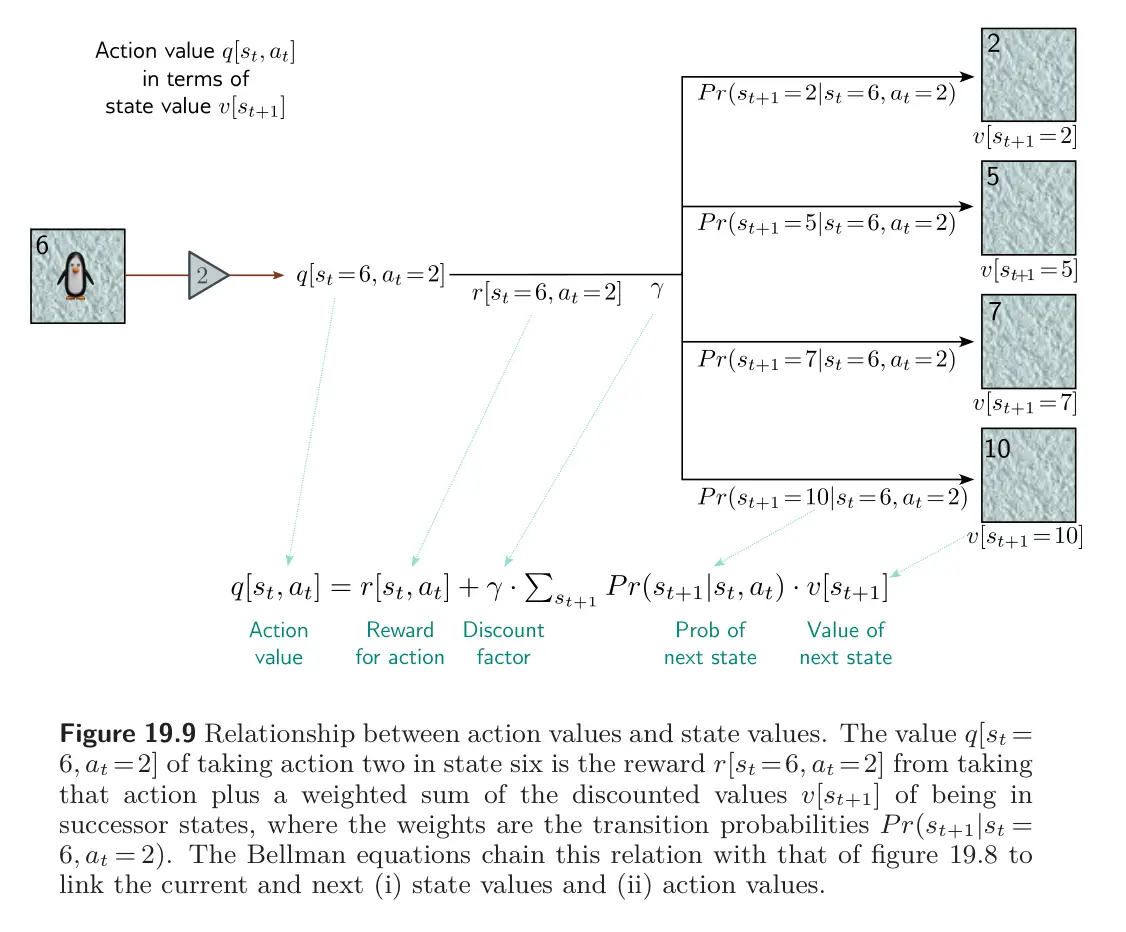
Substituting this equation into the state value equation above gives a relation between the state value at time and :
Substituting the equation into the equation gives a relation between the action value at time and :
These two relations are the Bellman equations and are the backbone of many RL methods. In short, they say that the state (action) values have to be self-consistent. Consequently, when we update an estimate of one state (action) value, this will have a ripple effect that causes modifications to all the others.