Latent variable models take an indirect approach to describing a probability distribution over a multi-dimensional variable . Instead of directly writing the expression for , they model a joint distribution of the data and an unobserved hidden or latent variable . They then describe the probability of as a marginalization of this joint probability so that:
Typically, the joint probability is broken down using the rules of conditional probability into the likelihood of the data with respect to the latent variables term and the prior :
This is a relatively indirect approach to describing , but it is useful because relatively simple expressions for and can define complex distributions .
Mixture of Gaussians
A mixture of Gaussians is a good example of a latent variable model.
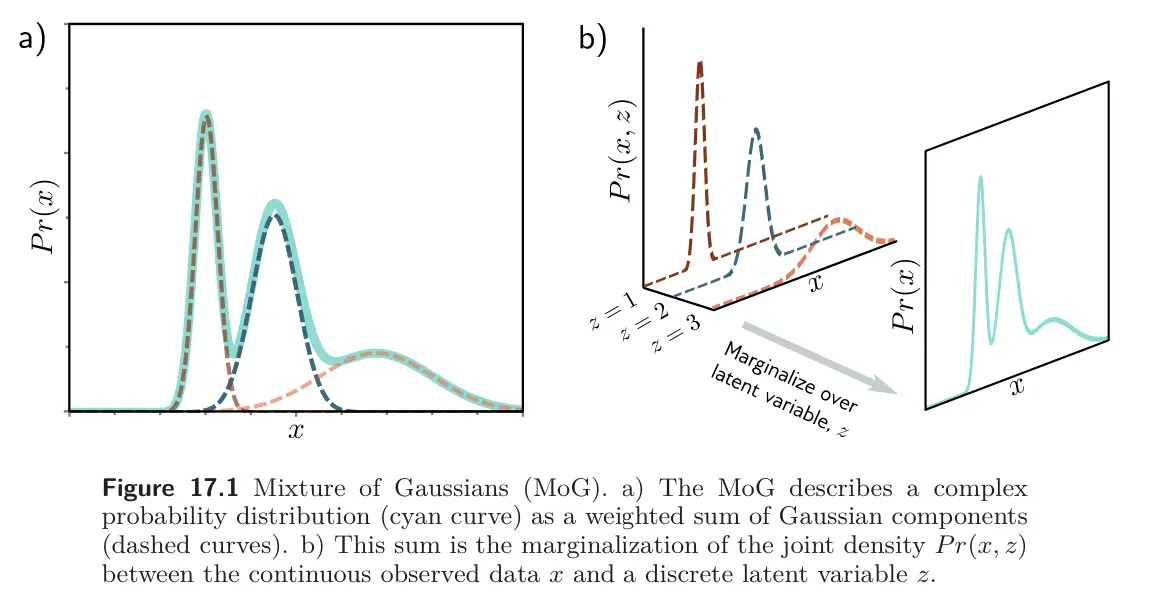
In a 1D mixture of Gaussians, the latent variable is discrete, and the prior is a categorical distribution with one probability for each possible value of . The likelihood of the data given that the latent variable takes value is normally distributed with mean and variable :
As we saw above, the probability is given by the marginalization over the latent variable . Here, the latent variable is discrete, so we sum over its possible values to marginalize:
Even from simple expressions for the likelihood and prior, we describe a complex multi-modal probability distribution.
We can also extend to Nonlinear Latent Variable Model.
dl
Latent variable model
?
Instead of modeling directly, model a joint distribution of the data and an unobserved hidden or latent variable . Then, describe as a marginalization of this joint probability:
+++