ViT
- Divide image into patches, which are mapped to input embeddings (with learned 1D positional encodings)
- Learnable
<cls>token is prepended to the sequence of patch embeddings - During self-attention, the
<cls>token attends to all image patches and accumulates information about the entire image - After the final transformer layer, the output embedding for
<cls>passes through an FC layer to create activations, which are then softmaxed to generate class probabilities
The Vision Transformer tackled the image resolution problem in using transformers for images by dividing the image into patches. Each patch is mapped to an input embedding via a learned linear transformation, and these representations are fed into the transformer network. Like ImageGPT, standard 1D positional encodings are learned.
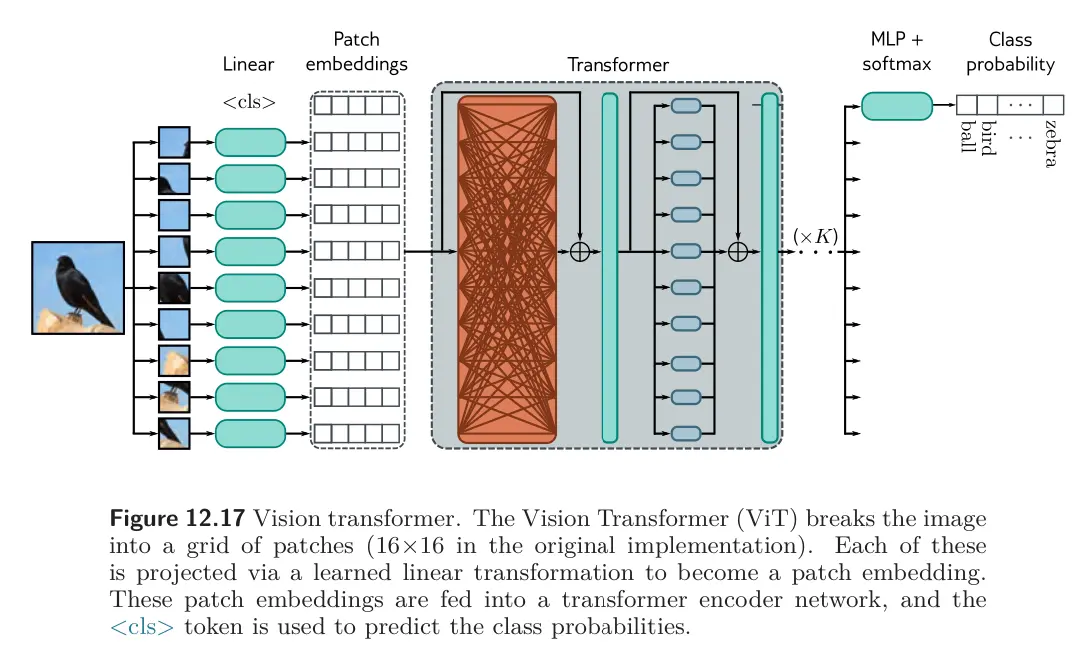
ViT is an encoder transformer. A learnable <cls> token is prepended to the sequence of patch embeddings before they are fed into the transformer. During self-attention, the <cls> token attends to all image patches and accumulates information about the entire image. After the final transformer layer, the output embedding corresponding to the <cls> token is mapped via a final linear layer to create activations, which are fed into a softmax function to generate class probabilities.
Unlike BERT, another encoder model, ViT uses supervised pre-training on a large database of 303 million labeled images from 18,000 classes.
After pre-training, the system is applied to the final downstream classification task by replacing this final layer with one that maps to the desired number of classes and is fine-tuned.
For the ImageNet benchmark, the original ViT achieved an 11.45% top-1 error rate. However, it did not outperform the best contemporary convolutional networks without supervised pre-training. The strong inductive bias of convolutional networks can only be superseded by employing extremely large amounts of training data.