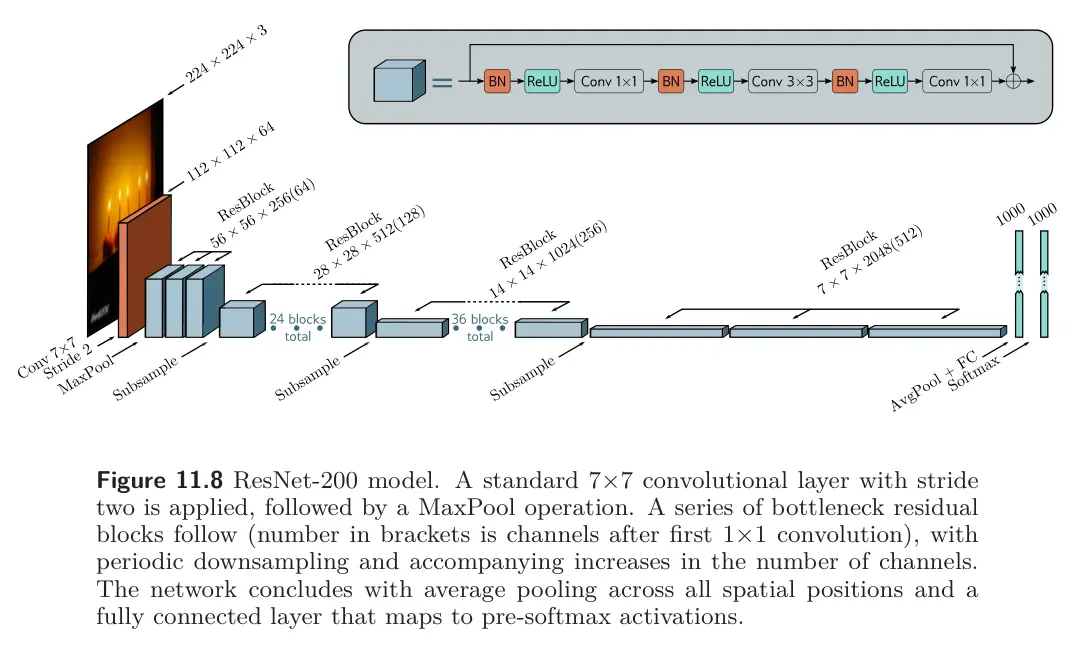
ResNets are networks using residual blocks, first used for image classification.
Basic ResNet block
What are the operations in a basic ResNet residual block?
(BatchNorm, ReLU, Conv) twice, then add back input with skip connection.

Bottleneck residual blocks
A bottleneck residual block comprises of what three convolutions?
- kernel to reduces the number of channels (see 1x1 convolution).
- kernel
- kernel to increase the number of channels back to the original amount.
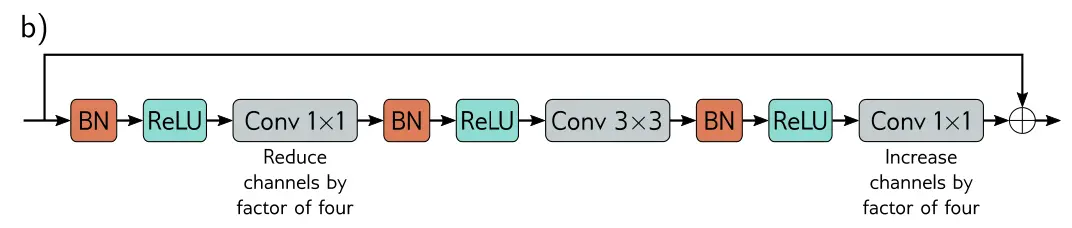
Why do we use bottleneck residual blocks?
Uses less parameters than a normal residual block, useful in deep networks.
Architectures
As an example of ResNet architectures, we examine ResNet-200. ResNet-200 contains 200 layers and was used for image classification on ImageNet. The architecture resembles AlexNet and VGG but uses bottleneck residual blocks instead of vanilla convolutional layers. As with AlexNet and VGG, these are periodically spread out with decreases in spatial resolution and increases in the number of channels.
- The resolution is decreased between adjacent ResNet blocks using convolutions with stride 2.
- To add channels, main convolutional path uses a convolutional kernel with shape , as is standard for 2D convolution. For the residual skip connection, we either append zeros to the representation or apply an extra convolution.
- At the start of the network is a convolutional layer, followed by a downsampling operation.
- At the end, a fully connected layer maps the block to a vector of length 1000, which is passed through a softmax layer to generate class probabilities.