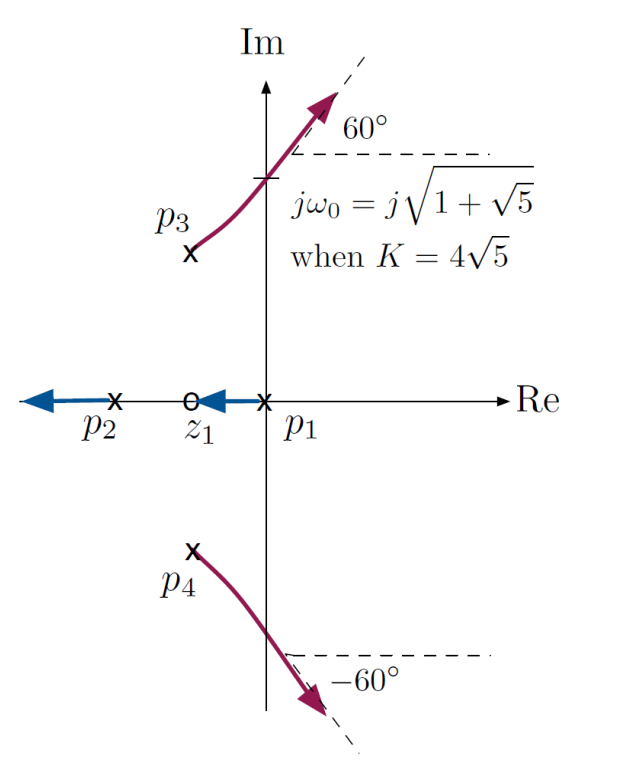
Let’s consider
Rule A:
Rule B: Branches start at open-loop poles:
Rule C: Branches end at open-loop zeros:
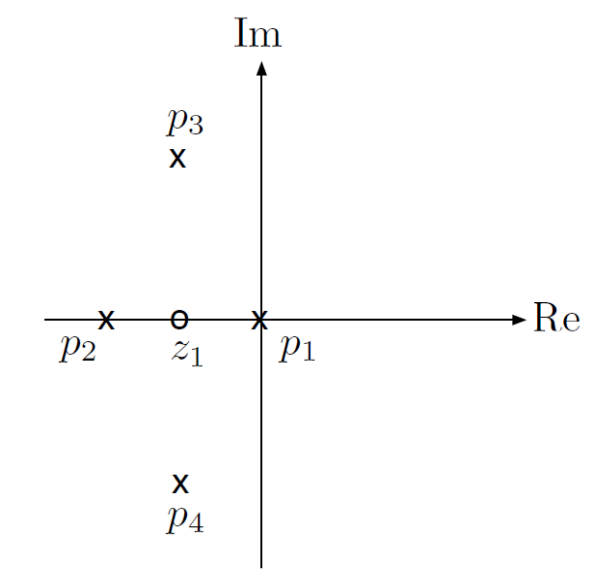
To determine which portions of the real axis lie of the root locus, we try a test point.
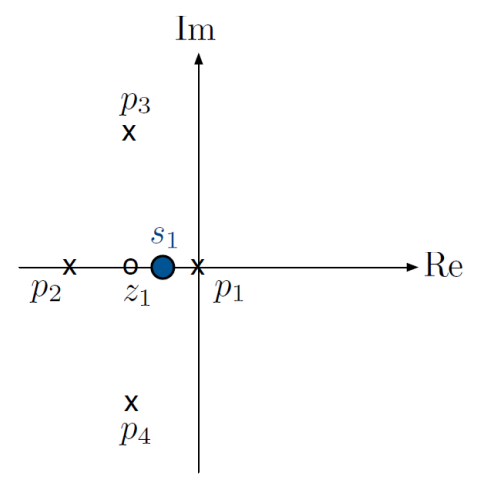
We can calculate the angles from to each zero and pole to determine if satisfies the pole condition.
We have
We can try another test point:
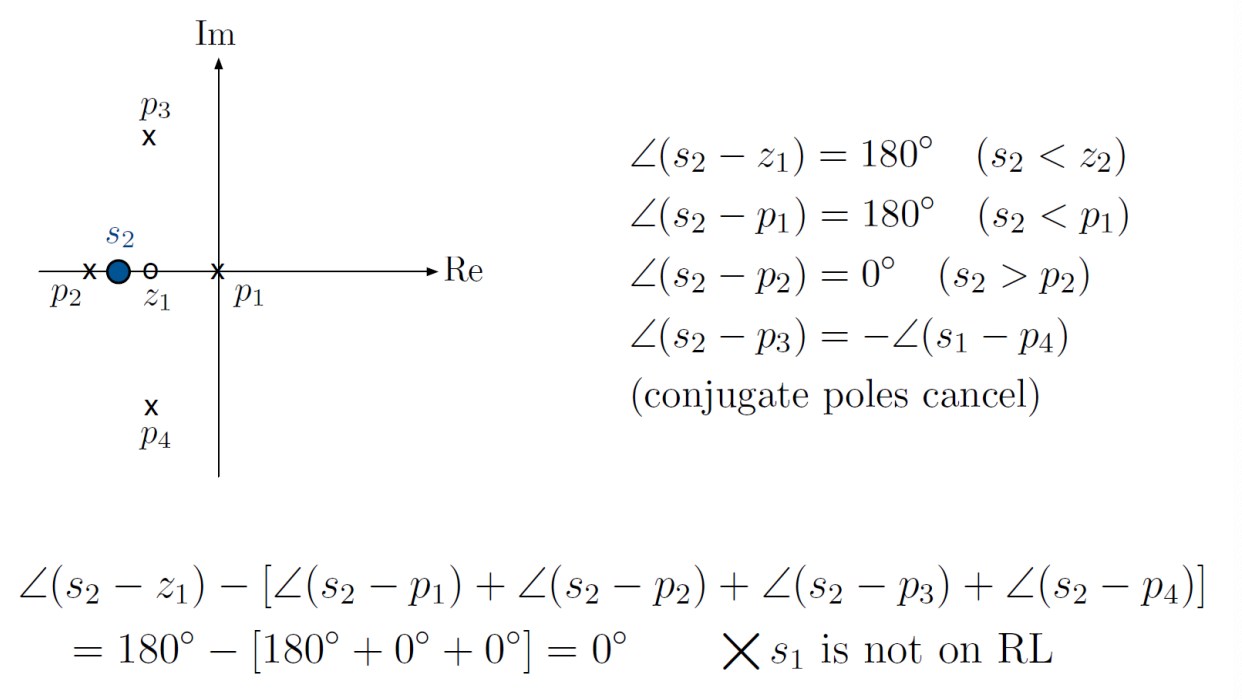
We can shorten this process by using Rule D:
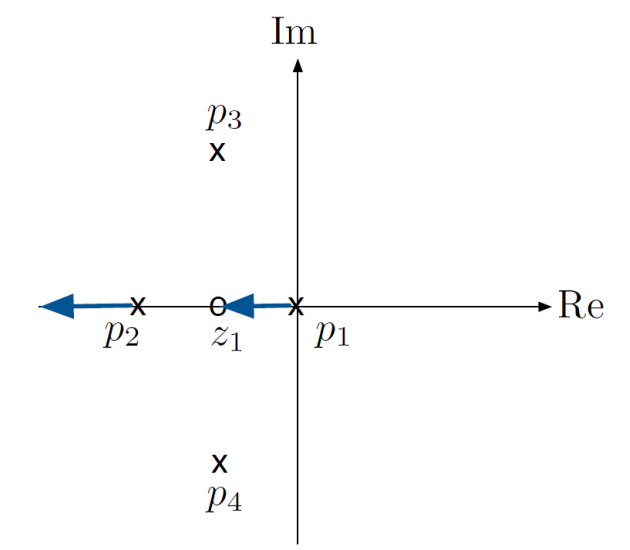
Rule E:
Then:
Thus, the asymptotes have angles .
For rule F, we see that the characteristic polynomial for our system is:
The Routh array:
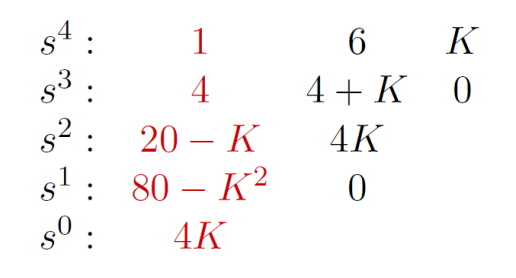
For stability, we need , , . Combining these, we see that the characteristic polynomial is stable for .
To find the crossing, plug in and solve:
- Real part:
- Imaginary part: , which gives .
Thus, we have -crossing at , when .