We apply two forces to the lever, and :
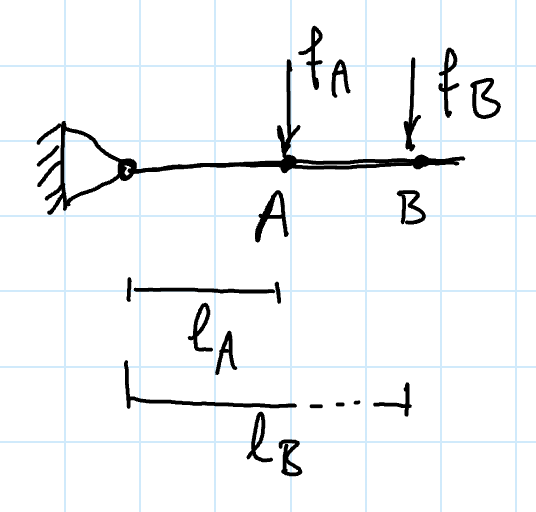
The moment of is , and the moment of is .
Static Case
For a static case, we want to solve for the forces needed to balance each other, so we have:
Deflection Case
Another type of problem we might want to solve is: If I have force at point , what force at would cause the same displacement?
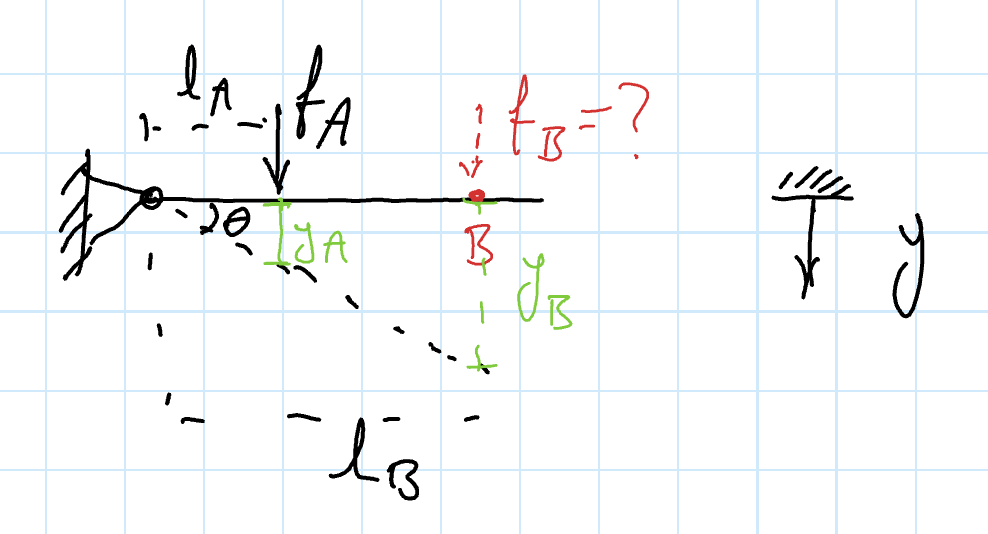
This time, we have:
For deflection, we have:
For small , we have:
Then, we can write:
or
Examples
Equivalent Spring
How do we move the spring from to while keeping the motion of the lever the same? What would the spring constant be compared to ?
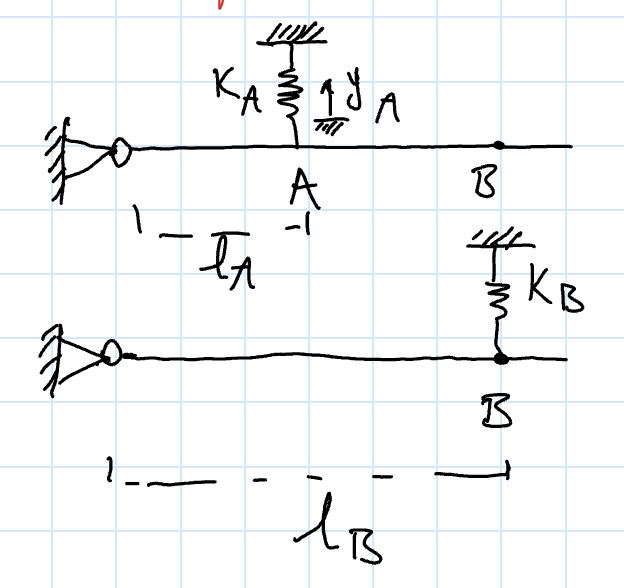
We can do this with an energy method, writing potential energy as:
Given that , we then have:
Solving for gives:
Equivalent Mass
Use kinetic energy to calculate the equivalent mass of the lever.
First, consider a mass at point on the lever:
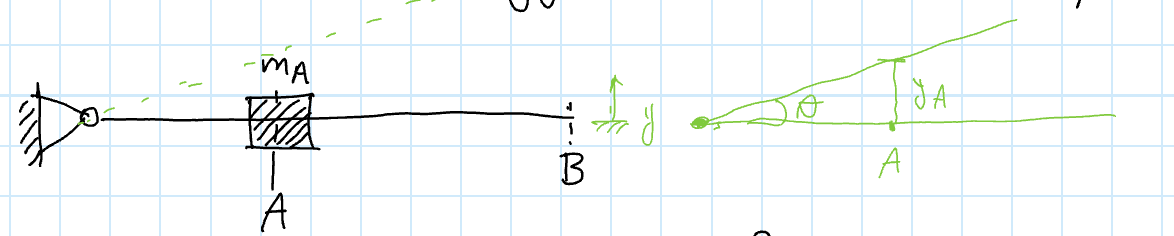
The kinetic energy is:
Recall that using the small angle approximation. Also, , where is the mass of the lever. Then, we have:
We can also find an equivalent system with just one mass at the end of the lever () with no inertia for the lever.

Because the two systems should have the same dynamics, their kinetic energies should be equal: