Let’s say we have a beam segment of constant cross section, subjected to a shear force and a bending moment at .
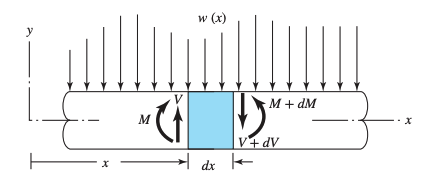
Because of external loading and , the shear force and bending moment change with respect to . At , the shear force and bending moment are and respectively.
This results in a stress distribution due to bending moments (considering forces in direction only).
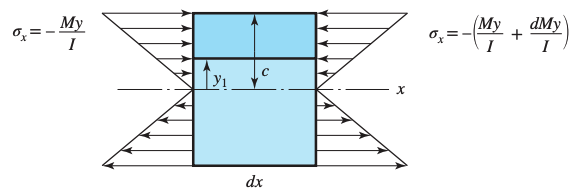
- If is positive, with the bending moment increasing, for a given , the stresses on the right face are larger than those on the left face
If we isolate the element further by taking a space at , the net force in the direction will be directed to the left with a value of
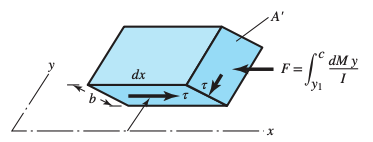
This shear force gives rise to a shear stress , where we have:
The term can be removed from within the integral and can be replaced by noting that , so that we have:
This integral is the first moment of area with respect to the neutral axis, called , defined as:
where, for the isolated area to , is the distance in the direction from the neutral plane to the centroid of area .
Thus, we can finally write the shear stress as:
- is shear force
- is the second moment of area of the entire section about the neutral axis
- is the width of the section at
- is the distance in the direction from the neutral plane to the centroid of
This is known as the transverse shear stress. It is always accompanied with bending stress.
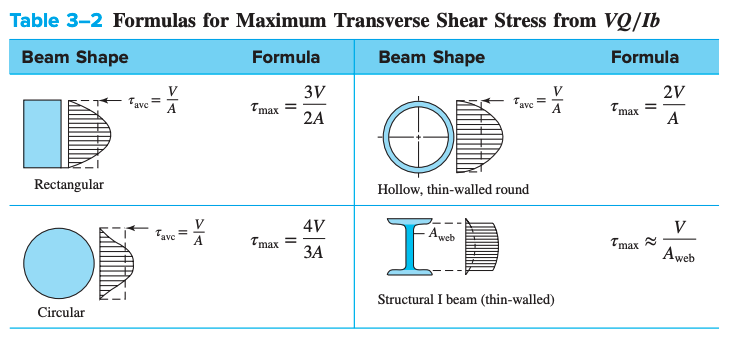
- Observe that the transverse shear stress in each of these common cross sections is maximum on the neutral axis, and zero on the outer surfaces.
- This is the opposite of bending stress!