œThe Grashof condition predicts the rotation behavior of a four-bar linkage’s inversions based on link lengths only.
- Inversion: A mechanism inversion is said to occur when the fixed link is allowed to move, and an alternative link is fixed
Let:
- = length of shortest link
- = length of longest link
- = length of one remaining link
- = length of other remaining link
Grashof Classes
Grashof condition evaluates the mechanism into one of three classes:
Class I - Grashof Linkage
In this case, . The types of motions that are possible are:
- Ground link adjacent to shortest: Crank-rocker
- Ground shortest link: Double-crank
- Ground link opposite to shortest link: Grashof double-rocker
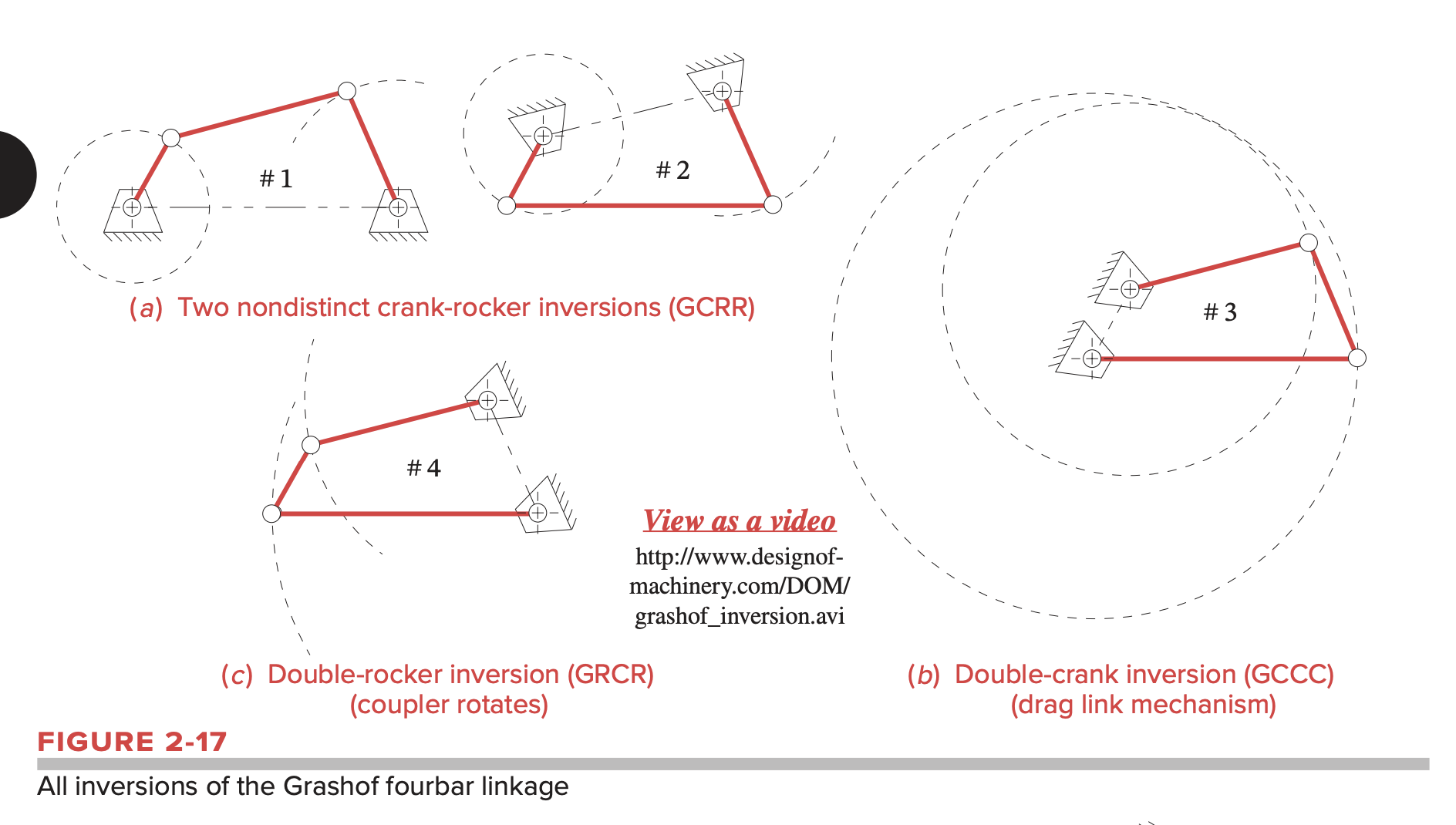
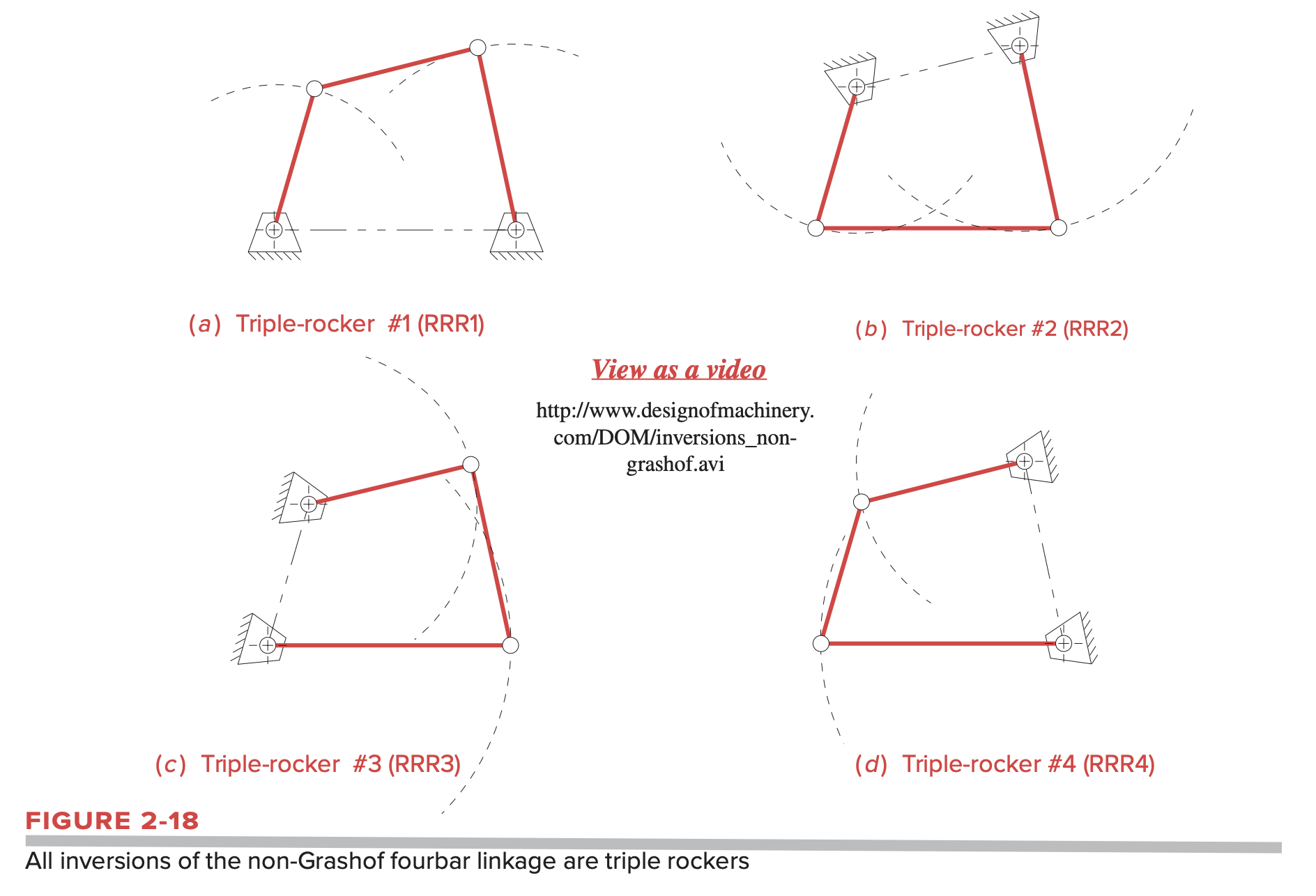
Class II - non-Grashof/Triple rocker
In this case, :
- All inversions will be triple-rockers in which no link can fully rotate.
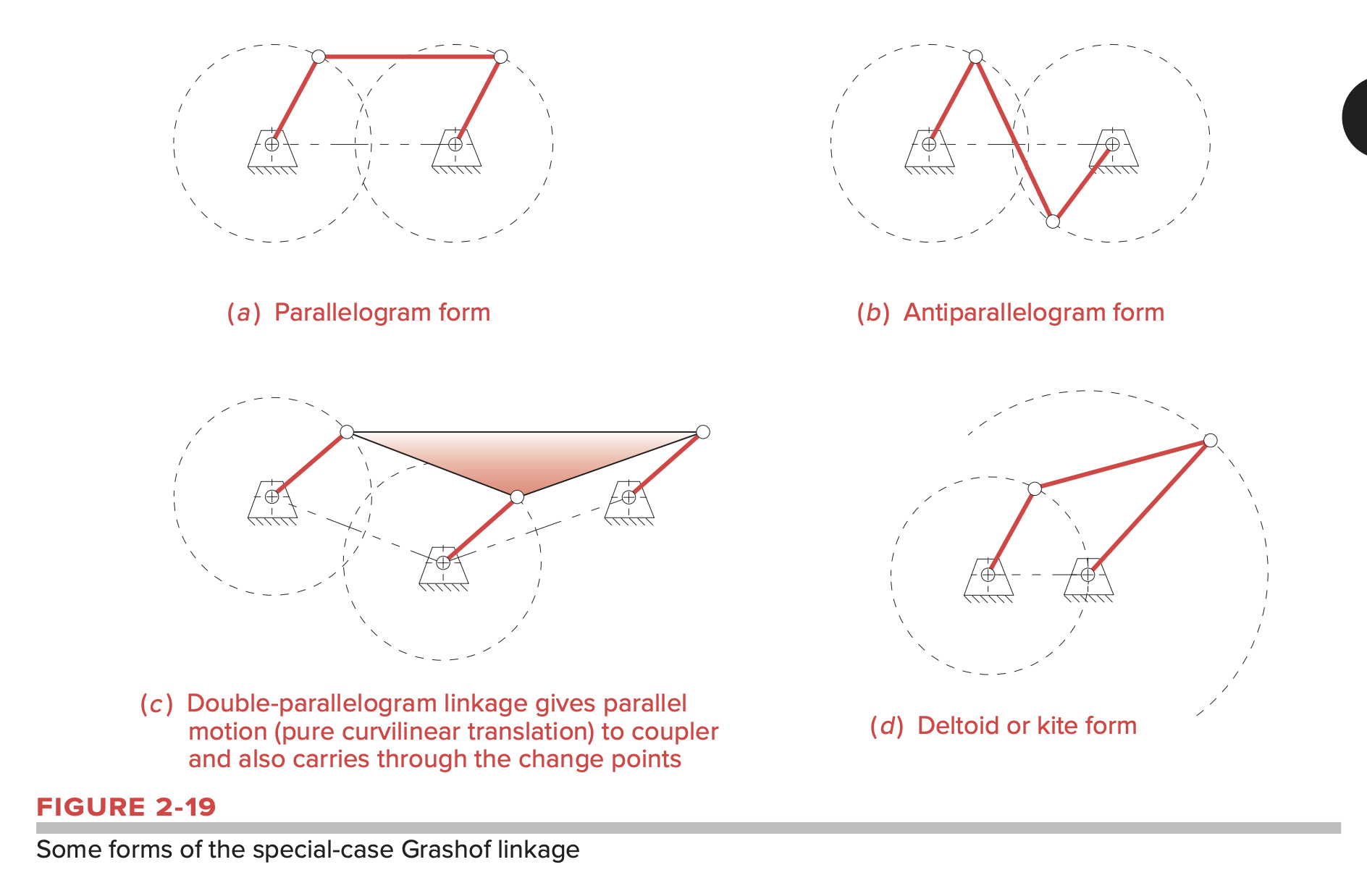
Class III (special-case Grashof)
In this case, .
- All inversions will be either double-cranks or crank-rockers but will have “change points” twice per revolution of the input crank when the links all become collinear. At these change points the output behavior will become indeterminate.
Barker’s Classification
Barker’s classification is a more fine-grained version of Grashof that allows for the prediction of the type of motion that can be expected from a fourbar linkage based on the values of its link ratios.
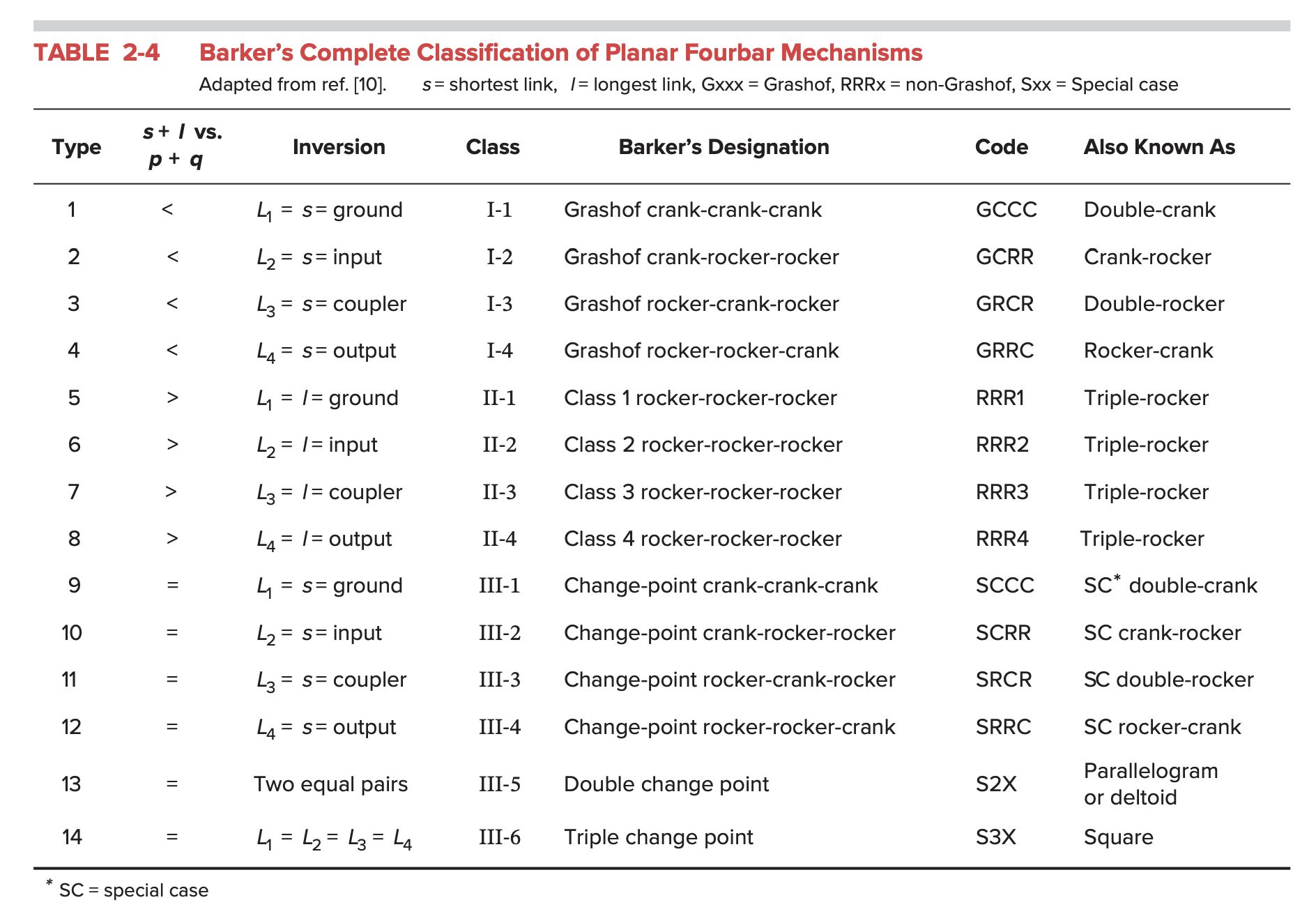
- 1-4: Grashof Class I
- 5-8: Grashof Class II
- 9-14: Grashof Class III