UWaterloo Tron: Review + Advice
Tron was not a mistake!
This post is a part-review, part-advice written at the end of my undergrad at University of Waterloo in the Mechatronics Engineering program (colloquially referred to as Tron). My aim here is to give a holistic, realistic summary of my Tron experience, and some advice that you might find helpful. Note that everything is written based on my personal experience and anecdotes from people around me; thus, it is definitely not representative of other people’s experiences. Take everything with a grain of salt!
Who is this for? This is primarily aimed at prospective students (or parents of prospective students) thinking about going to Waterloo for engineering, though much of the content would likely be helpful for current students as well. Essentially, I tried to answer the questions that I had when I was an applicant and in my younger years. I assume that the reader has some basic knowledge of Waterloo engineering; if there’s some terminology you don’t understand, you may need to search it up elsewhere.
TLDR: would I recommend Tron? Yes. I believe that Waterloo Engineering degrees have the best return-on-investment for Canadians, and Tron is a overall a great, flexible program that opens up a ton of different paths. Obviously, there are flaws (covered below), but overall my experience and the experience of many around me seems to be overwhelmingly positive.
Overview
What exactly is Mechatronics? At Waterloo, the Tron program includes courses in mechanical, electrical, and software engineering to help you learn to build electromechanical systems. This ranges from autonomous vehicles to robots to 3D printers to smart thermostats; basically everything is an electromechanical system. Like all Waterloo Engineering degrees, Tron is part of the co-operative education program; we are required to complete at least 5 internships (“co-ops”), littered throughout the degree. Most people do 6. Because of the co-op structure, the degree is 4 years and 8 months long (for example, I attended from September 2021 to April 2026). In contrast, the standard degree is typically a year shorter.
Academics
The Waterloo Engineering program consists of 8 study terms where you take courses at school. Every term typically consists of 5 or 6 courses; typically, you will have five technical engineering courses every term, and maybe one non-engineering elective as your 6th course. In 4A and 4B you will get to pick some of the technical courses (known as technical electives or TEs); before that, everything is picked for you (more on this later). Interestingly, Mechatronics is often grouped together with mechanical engineering at Waterloo due to being in the same Department of Mechanical & Mechatronics Engineering (MME). In actuality, the courses are administered by several departments in collaboration, with most of them being from ECE and some also from SYDE. If I recall correctly, we were told that the proportion for ECE/ME/SYDE/SE is 60/20/10/10.
Curriculum
The most unique aspect of Tron compared to Waterloo’s Engineering programs is its breadth – we learn foundational skills in a lot of areas. Looking at the course list, this starts with fundamentals of math/physics/engineering in 1A/1B, expands to more advanced topics ranging from thermodynamics to control systems in 2A/2B/3A/3B, and advanced technical electives in 4A/4B.
There are pros and cons to the breadth of Tron. The upside is that if you’re a high school student with a broad idea of “I want to be an engineer” but no specific idea of what you want with respect to mechanical vs. electrical vs. software, Tron offers exposure to everything. Similarly, it offers relatively more flexibility than other programs; people around me in Tron become successful mechanical, electrical, and software engineers. People even go into quantitative finance! I think this flexibility is rare in other programs; for example, a Software Engineering or CS major is much more locked in to a specific niche.
The downside is that you naturally have to trade depth for the breadth. Because we have to take more foundational classes covering several different areas, you get less courses that dive deeper into a topic. Thus, a common issue for Trons is that after a few co-ops, they find out that they really like one area (e.g., software), and don’t really like other areas (e.g., mechanical and electrical) as much. Then, when they come back to school, they want to just take more software courses, but are forced to keep taking mechanical and electrical courses, with no technical electives until the final year. It’s also not straightforward to just transfer to another program in Waterloo; the credit transfer process is messy so you might have to delay graduation. This is definitely a very real downside of Tron; if you are already sure that you like a specific area, try and get into that program first.
I specialized into software (robotics software specifically) very early, but decided to stick in Tron. The above sentiment of not enough breadth was not a huge concern for me; I felt that I could overcome the lack of depth, as I always learned a ton on the job during co-op. I also have fairly strong self-directed learning ability, spending a significant amount of time reading textbooks in topics I’m interested in. This has also been made easier by LLMs as one can access to a fairly good personal tutor at a low cost. Furthermore, I felt that it was good to not overspecialize this early on in my career, but instead establish a solid foundation in a broad variety of topics. This is partially for job prospects: despite my software-heavy resume and lack of knowledge compared to my mechanical- and electrical-focused friends, I don’t think it would be that difficult to pivot if I wanted to. On a more abstract philosophical, I just wanted to know more about the broader world and how it works instead of having tunnel vision. While I most likely won’t ever use something like fluid mechanics on the job, why not learn something interesting? And maybe it’ll show up in useful ways down the line!
The main downside of the Tron program, however, is definitely its lack of choice in terms of coursework. While it’s true that you get to take a variety of courses, you don’t actually get to pick what those courses are! 30 out of your 32 courses up to 3B are chosen for you (you get two non-engineering electives), and you finally get some technical electives in 4A and 4B. Thus, you are likely not going to enjoy every course you take, and many may not be relevant to your specific interests. When you finally reach technical electives in 4A and 4B, you will have already completed your co-ops, making it more difficult to apply the knowledge from those courses that better align with your interests.
Courseload and difficulty
One of the most common questions Is Waterloo engineering hard? Is it stressful? In my opinion, yes and no. Obviously this will vary from person to person, but my experience has been that it easy to do decently but hard to do well. My approximation of the GPA-to-effort curve is shown below.
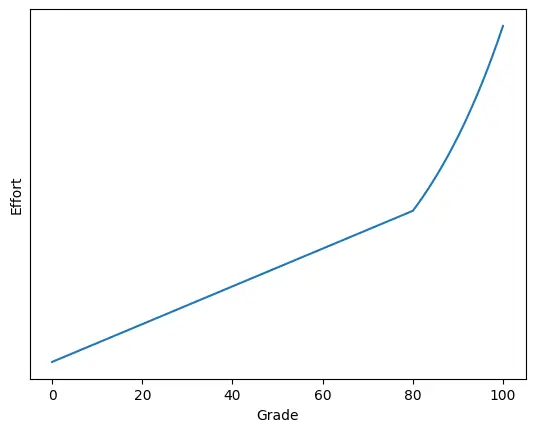
Specifically, I have found it is fairly trivial to get an average around 80% with light studying (just cramming before exams); this is basically what I did in my 1B/2A terms. Much of the time, there are lab, assignment, or project components to your final grade that are relatively easy to do well on; then, you just have to not do catastrophically terrible on your exams and you’ll land somewhere around an 80%. However, I found that it’s quite a bit harder to do well, like getting an average above 90%. While certainly not impossible, the margin for error becomes much smaller. On a heavily weighted final exam (for example, my Calculus II final was worth 65% of the total course grade), just a couple wrong answers might immediately take your mark out of the 90-100% range. Thus, getting a higher average requires exponentially more time and effort to make as few errors as possible.
Of course, all of this is dependent on the term-specific courseload and professors, etc. Certain professors or courses give out lots of high marks, while others like to throw in difficult test questions or have extremely time-consuming labs. UW Flow is a good resource to find info on things like this, although you often won’t get a choice anyway!
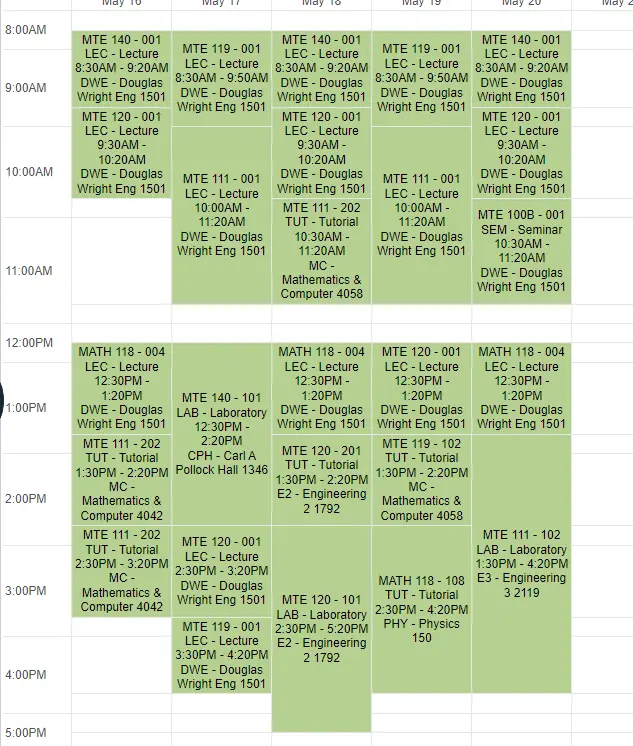
In terms of time commitment and stress, you’ll definitely be busy during school terms. Even if you are saving all the cramming for the night before an exam, there’s still a steady stream of deliverables to hand in. At the same time, it’s probably not all that bad, and certainly not as bad as the impression left by the scary-looking timetables (see an example below). Lecture attendance is not mandatory (though often helpful!), tutorial attendance is even less mandatory, and many labs are only bi-weekly. You can definitely have a social life, exercise, and party while still doing reasonably well in school.
One common criticism of Waterloo that relates to courseload difficulty and stress is the quality of instruction. Often, course content might not actually be super challenging, but doing well in the course is challenging due to the quality of instruction, whether that be the quality of the lectures, assignments/projects, exam preparation materials, and exams themselves. I strongly agree with this criticism; while there are certainly great professors, I felt that Waterloo could do a much better job encouraging higher quality of instruction. I’m not able to compare to other institutions, so it may be a broader issue in academia in general (maybe maybe professors are hired for research and not their teaching ability?), but I definitely feel that this is one of the most fair criticisms of Waterloo.
Do grades even matter?
Most of the time, not really. Very few employers even ask for your GPA. There are only a few cases that I can think of:
- You want to go to grad school. Then, you probably want to maintain at least an 85%, and the higher the better.
- You are searching for your first few co-ops. GPA may factor more into your first few co-op searches because you don’t have much else on your resume to stand out.
- There are a few employers and opportunities that do ask for your GPA. The ones that I’m aware of are certain quant shops and academic research internships. Notably, doing a Waterloo Undergraduate Research Assistantships (URA) requires a GPA of 80% in the previous term.
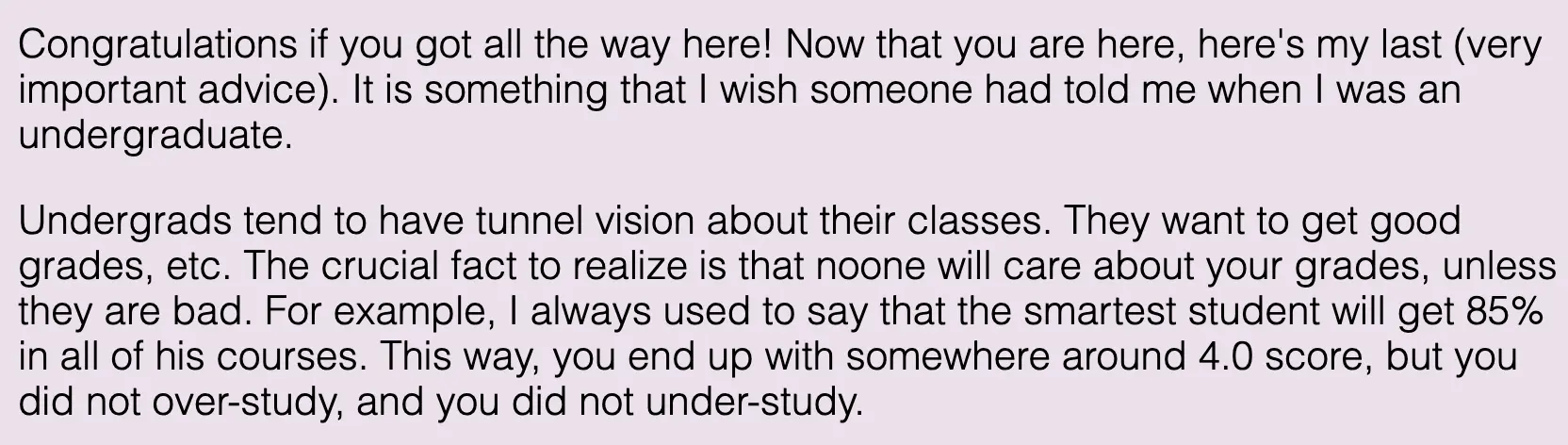
Thus, I think a nice sweet spot for most people is in the 80-87% range. At this level, your GPA is good enough that you won’t ever get questioned about it or lose any opportunities, you don’t need to put in so much effort that you have no life outside of school; there’s plenty of time to look for co-op positions (this can be very time consuming!), and do all the other things you want to do. This is basically the same advice that Andrej Karpathy gave in his advice post:
Exchange
In later terms, typically 3A or 3B, many students choose to go on exchange. I went on exchange during my 3B term to the Hong Kong University of Science and Technology (HKUST). I highly highly recommend this.
Typically, you take equivalent courses at your exchange school, which are approved by an advisor. Oftentimes courses will not line up perfectly so you may have to make up courses before you go on exchange or after you come back; I took two of 3B courses during co-op before exchange. Notably, courses taken over exchange are taken as Credit/No Credit; as long as you pass they’ll just give you the credit on your transcript. This means you can slack off and travel as much as you want, and as long as you pass, it won’t affect your GPA negatively. (Although conversely, if you do really well it won’t positively impact your GPA either). During my 4-month exchange, I spent almost half the time traveling to 8 different countries and made great memories with new friends.
Transfers
From what I’ve seen, transferring in and out of Tron is not very difficult but certainly not trivial. People who transferred in from other Engineering programs such as Mechanical Engineering and Environment Engineering had to make up missing courses. It depends on when you transfer, but sometimes you may have to take an extra year to graduate.
Make sure you have a good reason to transfer! I’ve seen some people transfer to programs like CS with the aim of getting better software co-ops, but end up getting worse software co-ops than Trons. There are certainly valid reasons to transfer (really don’t like the content, looking for a lighter workload), but differences in co-op opportunities should not be one of them in my opinion. I’ve seen Trons get jobs at almost every conceivable company one might want to work at. At least in terms of name/brand value, all of the major degrees at Waterloo (CS/SE/Math/ECE/MTE/SYDE/ME) have little difference. If you’re having trouble getting co-ops and in one of these programs, your program is probably not the main cause.
In more rare cases, I’ve also seen people transfer to other schools. Waterloo certainly might not be for everybody, so this is understandable. This is likely much more personal/school-dependent, so I don’t have much to comment on here.
Dropping out
Some people choose to drop out. This can be for a variety of reasons, from not being able to handle the coursework, to founding a startup or joining a company full-time. Once again, this is very circumstance-dependent so I don’t have much to say here. What I will say is, in general, having a degree is very useful; for example, it’s much harder to get a visa to work in another country without a degree. I think in most cases the upside of a degree and also experiencing college life for 5 years is worth the time investment. So think carefully before dropping out!
Co-op
Everyone knows that the co-operative education program is the most famed part of Waterloo. In general, we are given the opportunity to do 6 co-op terms, 4 months each for the chance to get 24 months of total experience. There is some flexibility to this: for example, it’s possible to graduate with only 5 co-op credits, or take 8-month positions that count for 2 credits. I personally did 6 co-op terms at 4 different companies for a total of 23 months of work experience (one of the co-ops was only 3 months long).
The Waterloo co-op is famous for good reason; I would go so far to say that it singlehandedly carries the value of the degree. Waterloo indisputably produces some of the best graduates it comes to employability. Many are able to get high-paying positions in the tech industry across the world. Why is this?
The first reason is the sheer volume of work experience. Internships are one of the most effective ways to become employable, but a typical four-year program realistically gives you three opportunities (one per summer) for a total of about twelve months. Waterloo effectively doubles that exposure, which is a huge resume boost. More work terms also means more chances to explore. Instead of committing early to a narrow path, you can rotate across roles, companies, and even industries, gradually refining preferences. This kind of iterative discovery is difficult to replicate in a traditional program. Just as importantly, repeated exposure to recruiting cycles builds interview skill, a form of experience that compounds quickly and is often undervalued.
There is also some structural advantage in terms of progression. Landing a highly competitive, well-paying role on a first attempt is unlikely with little or no experience. Most people begin with smaller companies or research roles, then leverage that experience to move into more recognized organizations, and eventually into top-tier positions (however you want to define this is up to you – it could be compensation, impact, or interest). Having six cycles instead of three effectively doubles the number of attempts to make that progression. It creates room for early missteps while still allowing time to recover, improve, and advance.
All of this can be taken together as a sort of compounding return or a positive feedback system. More work terms lead to a stronger resume; a stronger resume increases the likelihood of securing better roles; better roles further strengthen the résumé. Each cycle builds on the last. By graduation, many students already have full-time offers from highly competitive employers; this would be significantly harder to reach, or at least far less predictable, without the additional iterations the Waterloo’s co-op structure provides.
One valid point is that you still start at the same position as other schools; as a first-year, everyone has basically nothing on their resumes. Waterloo tries to make this a bit easier through their internal job board, WaterlooWorks, such that you have less competition (don’t have to compete against other schools). I definitely found WaterlooWorks to be helpful in securing my first few positions, but it certainly does not “guarantee” you a job in any way; lots of people struggle with finding their first few co-ops. After the first few, people tend to move off of WaterlooWorks and just apply directly, to get access to a wider pool of jobs, taking advantage of the fact that their resume is now more likely to be strong enough to compete. There are also a few other small advantages provided by the Waterloo co-op model: for example, many of our internships are “off-cycle”, occurring in the winter or fall, avoiding the summer internship season where you have to compete with every other school in the world.
Co-op Advice
I think people tend to overcomplicate their co-op advice. In general you just want to follow this loop:
- Look at job descriptions to find out the qualifications/skills required for your dream job.
- Try to put things on your resume that prove you have the required qualifications and skills; this could be projects, design teams, or getting a job in a related area.
- Repeat!
That’s really all there is to it; following this, your resume will gradually improve in the direction of your dream job until you’re qualified for it. There is the separate problem of interview prep, but I believe there’s enough resources out there already. Most of the time, you just want to come off as qualified in the skills that they want, and maybe be able to solve whatever assessment or puzzle they throw your way; unfortunately, sometimes these assessments might not correlate to the actual job as is often the case with software engineering and LeetCode.
While the above sounds simple, it is very important to internalize that the job search process is inherently very random. You can have an incredibly qualified resume for a position but simply not have it seen by a recruiter. You can get unlucky with interviews. A lot of the time, especially early on in your career, it’s not a skill issue, so don’t be too discouraged if you fail. If you fail because of a skill issue, then just work on your skills, there’s absolutely no shame in that either.
Research
Undergraduate research is not as popular at Waterloo in the math/CS and engineering departments as other schools (due to Waterloo’s heavy industry focus), but does still exist. It primarily occurs in two forms:
- Undergraduate Research Assistantships (URAs) are part-time research opportunities with professors during school terms.
- There are full-time research co-op positions posted by university labs (both at Waterloo and at other schools), or by research organizations (such as the National Research Council), or by research-focused companies.
Let’s talk about URAs first. They generally require you to be in your 2A term and have at least an 80% in your previous academic term. Typically, you just have to email a professor that you’re interested in working with who has indicated that they are open to taking URAs. You typically get a \$1000 stipend for the term, or \$1500 if you are eligible for the President’s Research Award.
I am not a big fan of URAs. I think that doing good research requires a large amount of dedicated time and effort, which the part-time structure of the URA does not really provide. Of course, you can squeeze out more time for research by spending less time on classes; for example, see Rose Wang’s blog on undergraduate research, where she intentionally took low-commitment classes. However, this is hard to do at Waterloo engineering because you mostly don’t get to pick your classes, and also have to balance job-hunting for the upcoming co-op term. Thus, most URAs end up being fairly low-commitmment, which means that you don’t really do any actual meaningful research work; most people just get an extra line or two on their resume, which can still be useful but usually is not all that valuable. The vast majority of people do not get a publication out of a URA.
Outside of URAs, the other common option is full-time research as a co-op. This has the benefit of high time commitment, making it much closer to “real” research that academics do (although your projects will still limited by the short time frame of a 4 month co-op, whereas a PhD student has 5 years). The higher commitment means you are much more likely to produce meaningful, publishable research; my first co-op was a research position and I ended up with 3 first-author papers, which was a huge boost to my resume. One downside of research co-ops however is that they generally do not pay a ton, often being reliant on grants for funding, and might not be a big resume boost unless you are interested in graduate school or research-heavy fields. For example, if your goal is to be a software engineer, generally having research experience is not as valuable as industry internships. Thus, I would mostly recommend research co-ops if:
- You’re early in your career (1st and 2nd co-ops)
- You want to go into a research-heavy field (machine learning, biotech, etc.)
- The professor/researcher you are working with is well-respected and well-connected
- The project you are working on is cool
- You have the opportunity to publish
- You are want to try out research to see if you are interested in graduate school (PhD or research-based Masters)
Miscellaneous FAQ
Streams
A popular question that shows up often on Reddit is “should I choose stream 4 or stream 8?” This is an interesting question because it is both unimportant and greatly important at the same time.
From a co-op standpoint, a lot of advice online advocates for stream 8 because it give you more time until your first co-op, which gives you more time to prepare and beef up your resume. It also has co-ops 5 and 6 back-to-back at the end, so you can do 8 months at the same company, giving you a better idea of life as a full-timer and maybe making it easier to secure a full-time return offer. I don’t think this advice is wrong but I don’t think it’s particularly strong either; you can absolutely do perfectly fine in stream 4, and it has its own advantages. While stream 4 throws you into your first co-op search right away, it might be a bit easier to find a job because it’s for the winter term, not for summer, which is more competitive. Furthermore, I think the back-to-back co-op 5 and 6 are not necessarily better; while it is true that you can do an 8-month term this way, not many people I know actually did this, as most people prefer to seek out new experiences. In that case, the back-to-back terms might actually make your life more stressful, as you either have to find two jobs at once, or find your sixth co-op while still working at your fifth.
Finances
Waterloo Engineering is pretty expensive for Canadian standards; it’s probably one of the most expensive programs in the country. However, compared to the U.S., it is much much cheaper. For reference, my tuition per term was around \$7k CAD when I started and increased to \$10k near the end of my degree (per term, as an out-of-province student). Notably, you can make a lot of money on co-op to offset the cost, and the cost of living in Waterloo is relatively low. For most domestic Canadian students around me, people have made enough money from co-op or have solid full-time return offers such that no one seems to be stressed about debt, or are actually graduating with extra money. Thus, for domestic students, Waterloo seems to be a great choice from a financial standpoint.
If you’re an international student, this can be quite different, as the tuition is approximately 3.5x more. In that case, I’m much more hesitant to advocate for the financial benefits of Waterloo; I will say that it still seems to be much cheaper than American schools of similar caliber.
Life and Culture
One of the biggest complaints about Waterloo is the quality of life. Waterloo is definitely not as vibrant in terms of social life as some party schools, but I definitely still think there’s lots of stuff to do. People definitely party (especially for Halloween and St. Patty’s), and there’s plenty of chances to go to Laurier parties down the street as well.
Another aspect that is often criticized is the “toxic” culture. Supposedly, the co-op grind makes people very cut-throat and fosters a competitive environment. I really have not found this to be case. There are definitely some people who care heavily about things like prestige and clout, or treat every social interaction as a networking opportunity, but in general people are not like this. In reality, life is just not really a zero-sum game. Just because I got a high grade in some course, doesn’t mean you can’t do the same; there’s no set quota or forced curve. The same goes for jobs; just because I got a job at some company does not mean I took your spot (unless it’s some very very small company). Thus, the feeling is generally not that you are competing with your classmates but more like being in the trenches together. People are helpful and supportive when you ask for help with academics and job searching/interviewing. If you’re a current student and your friend group is not like this, maybe go make some new friends.
Why did I personally choose Waterloo and Tron?
Why did I specifically choose Waterloo when I was in high school? I got into some pretty good American schools, but the cost of tuition there is simply insane. It’s also hard to get large scholarships to cover the tuition (or I’m just not smart enough), especially as an international student; the most I got offered was $25k/year, which is sizeable but still not enough. One of my older cousins attended Waterloo and has been very successful in industry. Scrolling through LinkedIn, I found that this seemed to be the case for a lot of people, with plenty of Waterloo Alumni doing very cool stuff both during their degrees and after graduating. I was also considering UofT, but they seemingly ignored my application (don’t even get me started on this, still makes me mad to this day), so I ended up at Waterloo.
I was accepted into CS and SE as well but ultimately picked Tron. This was mostly just a personal preference; looking at the CS and SE courses, I didn’t really feel much interest. I think while I do like writing software, the scope of my interests in software is quite narrow, so many of the CS/SE courses simply did not speak to me. Tron is more grounded in the physical world (I really liked physics in high school), and seemed to be still keep the door to software open. Lastly, I liked the idea of having a broad base of knowledge, which Tron provided.
Waterloo vs. Stanford vs. MIT vs. …
How does Waterloo compare to other schools? I can’t really say for sure because I’ve never attended other schools; I can only make an educated guess based on my experiences at Waterloo and interacting with students from other schools.
Compared to the elite American schools, I would definitely say that Waterloo provides the same opportunities in the tech, finance and other adjacent spaces. Furthermore, the smartest students at Waterloo are probably on the same level as the smartest students from those schools; you can see this from things like competition results, etc. However, it is true that those schools usually have a higher bar for admission, lower acceptance rate, and larger candidate pool than Waterloo, so the average level at those schools might be higher.
If you have a Waterloo offer and an offer to one of these schools, I don’t think it’s an easy decision to make; these schools often have more clout, and for good reason. However, do keep in mind what I said before: Waterloo provides the same opportunities, especially in the tech, and its world ranking is still decent. It will also cost much less. Thus, the decision is still ultimately just up to your personal circumstances and desires.
Note that I strongly believe (obviously massively biased so take this with a grain of salt) that Waterloo is the best engineering school in Canada. I’m not saying Waterloo is some magical thing that will automatically grant you a good career; if you’re very smart, you can find a way to succeed anywhere. If you’re dumb, it’s not like Waterloo can’t save you either. My opinion is just that, on average, Waterloo will provide you with the most opportunities to succeed, as the chance to do 6 co-ops reduces reliance on luck, and you will be surrounded by smart people. If you really love research, maybe UofT EngSci is a better choice, although I would argue that you can just do research co-op terms at Waterloo. If you really value a pretty campus, UBC is fine too. Canadian engineering education in general is fairly solid, it’s not like choosing something other than Waterloo will automatically cause you to fail.
Personal statistics
Below I’ve compiled some numbers and statistics from my time in Waterloo for the curious to see.
Academics
Grade averages per term:
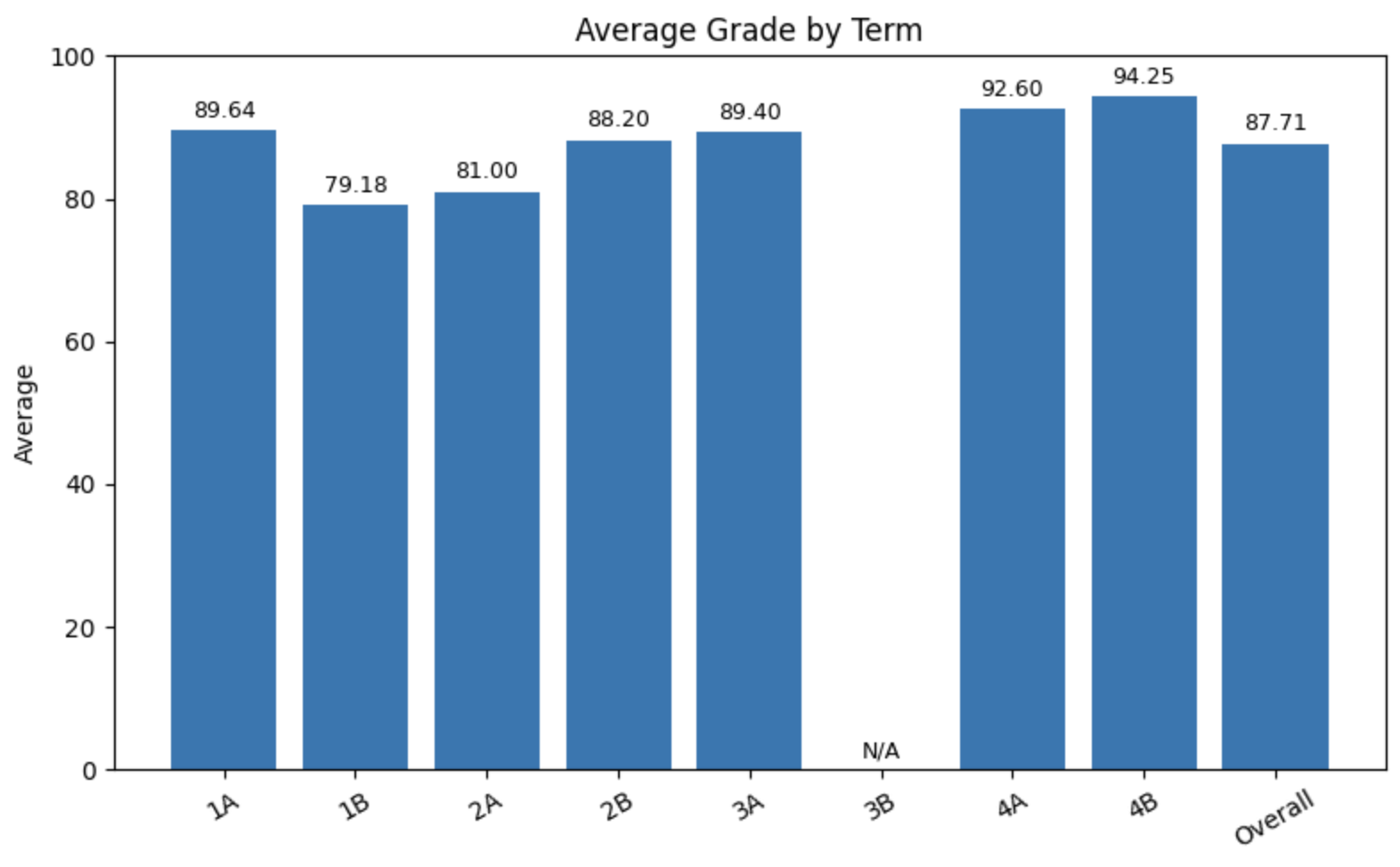
- Lowest grade: MTE 119 (64), Highest grade: MTE 241 (100)
- My grades were lowest in 1B and 2A. This was mostly because I was more focused on trying to secure good co-op positions, as getting good co-ops early obviously has a positive compounding effect. There were also some personal extenuating circumstances in 1B that caused lower grades (co-op got rescinded last minute). Thus, I would not say that 1B and 2A were especially hard terms, just that I wasn’t focused on school at all at the time.
- My grades were highest in 4A and 4B. This was mostly because I did not need to spend much time searching for a full-time job (got a return offer and only bothered interviewing for a few other companies), and because I chose somewhat easier technical electives. My GPA was also really close to the 87 cut-off for graduating with Dean’s Honours so I figured I might as well lock in and try to get it, although it doesn’t really matter for anything. Note that 4A and 4B are not necessarily easier than other terms either; it depends on the electives you take and your capstone project.
- The hardest term is probably 3B, since there are a lot of technical courses and MTE 381, a project course that can end up being a lot of work. However, I did 3B on exchange (hence why it’s N/A on the plot), so I don’t really know for sure.
Co-op
Co-op location and salary:
| Co-op term | Location | Hourly salary |
|---|---|---|
| 1 | Remote (lived in Waterloo) | $22.50 CAD |
| 2 | Waterloo, ON | $26.00 CAD |
| 3 | San Francisco, CA | $50.00 USD |
| 4 | San Fransisco, CA | $50.00 USD |
| 5 | Remote (lived in Waterloo) | $41.00 CAD |
| 6 | Santa Clara, CA | $70.25 USD |
Note that my hourly salary calculation here includes all compensation that lands in my bank account, such as housing stipends for my 6th co-op term. However, it excludes other perks such as plane tickets, free food, gym access, etc.
Tron Alumni
Below is a non-exhaustive list of people who graduated from Waterloo Mechatronics and work on cool things (at least in my view), in no particular order.
- Russell Wong
- Alex Rodrigues
- Clayton Haight
- Ethan Childerhose, Owen Brake
- Sanjeevani Lakshmivarahan
- Matt Rendall, Ryan Gariepy